DIGESTION • GUT MICROBIOME • NUTRITION • MEN'S WELLNESS

Digestive & Gut Health for Men

An evidence-informed guide to digestion, the gut microbiome, fiber, food, daily habits, common digestive symptoms and responsible gut health supplement decisions.

Digestion → Gut Microbiome → Food & Fiber → Daily Habits → Better Decisions
✓ Evidence-Informed
✓ Food First
✓ Gut Microbiome
✓ Supplement Context
MENFUEL GUIDE PRINCIPLE Digestive Symptom ≠ Diagnosis

Gut health is broader than one food, one probiotic or one supplement. Understanding digestion, diet, symptoms and individual context comes first.

QUICK NAVIGATION

Explore Digestive & Gut Health

Start with how digestion works, then explore the gut microbiome, food and fiber, everyday habits, common digestive symptoms and the evidence behind gut health supplements.

RECOMMENDED READING PATH
01 Digestion
→
02 Microbiome
→
03 Food & Fiber
→
04 Daily Habits
→
05 Symptoms
→
06 Supplements
KEEP THESE DISTINCTIONS IN MIND

Gut Health Requires Context

01 Digestive Symptom ≠ Diagnosis

Bloating, gas, constipation and other symptoms can have different causes and should not be used alone to identify a specific condition.

02 “Gut Health” Claim ≠ Proven Benefit

A digestive-health marketing claim does not automatically establish that an ingredient or finished product has a meaningful clinical effect.

03 More Probiotic CFUs ≠ Better Product

Probiotic evaluation requires more context than the largest number printed on a product label.

MENFUEL GUIDE APPROACH Start With the Digestive Foundation

Before focusing on probiotic capsules or complex gut-health stacks, understand digestion, food quality, fiber, dietary variety, everyday habits and the reason a supplement is being considered.

Understand → Support the Foundation → Evaluate Symptoms → Consider Supplements in Context
THE DIGESTIVE SYSTEM

How Your Digestive System Works

Digestion is a coordinated process that breaks food down, moves it through the gastrointestinal tract, absorbs nutrients and water, and eliminates material the body does not need. Several organs work together throughout this process.

A CONNECTED SYSTEM

Digestion Involves More Than the Stomach

The digestive tract extends from the mouth to the anus. Food moves through the mouth, esophagus, stomach, small intestine and large intestine while accessory organs such as the liver, gallbladder and pancreas contribute substances that support digestion.

Different parts of the system perform different jobs. Some mechanically break food into smaller pieces, some contribute acids or digestive enzymes, and others are especially important for nutrient or water absorption.

01 Break Down Food

Mechanical and chemical processes transform food into components the body can process and absorb.

02 Absorb Nutrients

The small intestine is a major site where digested nutrients are absorbed and moved into circulation.

03 Absorb Water

The large intestine absorbs water and electrolytes while helping form stool.

04 Eliminate Waste

Material that remains after digestion and absorption ultimately moves toward elimination.

Educational illustration showing the human digestive system and the major organs involved in digestion
The digestive system includes the gastrointestinal tract and accessory organs that contribute to digestion.
FOLLOW THE JOURNEY

From Food to Nutrient Absorption

Each stage contributes something different to digestion. The process is continuous rather than a collection of completely separate steps.

01

Mouth

Chewing mechanically breaks food into smaller pieces, while saliva helps moisten food and begins the digestion of some nutrients.

02

Esophagus

Muscular contractions move swallowed food from the throat toward the stomach.

03

Stomach

The stomach mixes food with acid and digestive substances, creating a semi-liquid mixture that continues toward the small intestine.

04

Small Intestine

Much of chemical digestion is completed here, and this is also a major site for the absorption of nutrients from digested food.

05

Large Intestine

The colon absorbs water and electrolytes, helps form stool and contains a large community of microorganisms.

06

Rectum & Anus

Stool is stored in the rectum before being eliminated through the anus.

SUPPORTING ORGANS

The Liver, Gallbladder & Pancreas

Food does not pass directly through these organs, but they contribute important substances to the digestive process.

01 Liver

The liver produces bile, which contributes to the digestion and absorption of fats.

02 Gallbladder

The gallbladder stores and concentrates bile and releases it into the small intestine when needed.

03 Pancreas

The pancreas releases digestive enzymes and bicarbonate into the small intestine, supporting the digestion of carbohydrates, proteins and fats.

MECHANICAL DIGESTION

Physical Breakdown

Chewing and muscular movements physically break food into smaller pieces and mix it with digestive secretions.

+
CHEMICAL DIGESTION

Molecular Breakdown

Acids, enzymes and other digestive substances help break larger food components into forms that can be absorbed.

AN IMPORTANT DISTINCTION

Digestion and Absorption Are Related—but Not Identical

Digestion breaks food into smaller components. Absorption is the movement of nutrients, water and other substances from the digestive tract into the body's internal circulation.

01 Food
→
02 Digestion
→
03 Absorption
→
04 Nutrient Use
M
THE NEXT LAYER

Digestion Also Involves the Gut Microbiome

The digestive tract is home to a large and diverse community of microorganisms. These organisms interact with food and the intestinal environment, adding another layer of complexity to digestive and gut health.

Microbiota, microbiome, probiotics and digestive health are related concepts—but they are not interchangeable.
MENFUEL GUIDE TAKEAWAY Digestion Is a System, Not a Single Organ

Mouth, stomach, intestines, liver, gallbladder, pancreas, digestive secretions, muscular movement and intestinal microorganisms all contribute to the broader digestive process. Understanding that system makes it easier to evaluate food, symptoms and gut-health products in the proper context.

THE GUT MICROBIOME

The Gut Microbiome: What It Is & Why It Matters

Your digestive tract is home to a complex community of microorganisms. Together, these organisms interact with food, the intestinal environment and the body in ways that connect digestion with metabolism, immune function and other aspects of human health.

A COMPLEX ECOSYSTEM

Your Gut Contains an Entire Microbial Community

The gastrointestinal tract contains bacteria, viruses, fungi and other microorganisms. Their abundance and composition vary throughout the digestive system, with particularly large microbial communities found in the colon.

These microorganisms do not simply exist beside us. They interact with dietary components, with one another and with the intestinal environment.

IMPORTANT TERMINOLOGY Microbiota and Microbiome Are Related—but Not Identical

Microbiota generally refers to the microorganisms present in a particular environment. Microbiome is a broader term that can include those microorganisms, their genetic material and their surrounding biological environment.

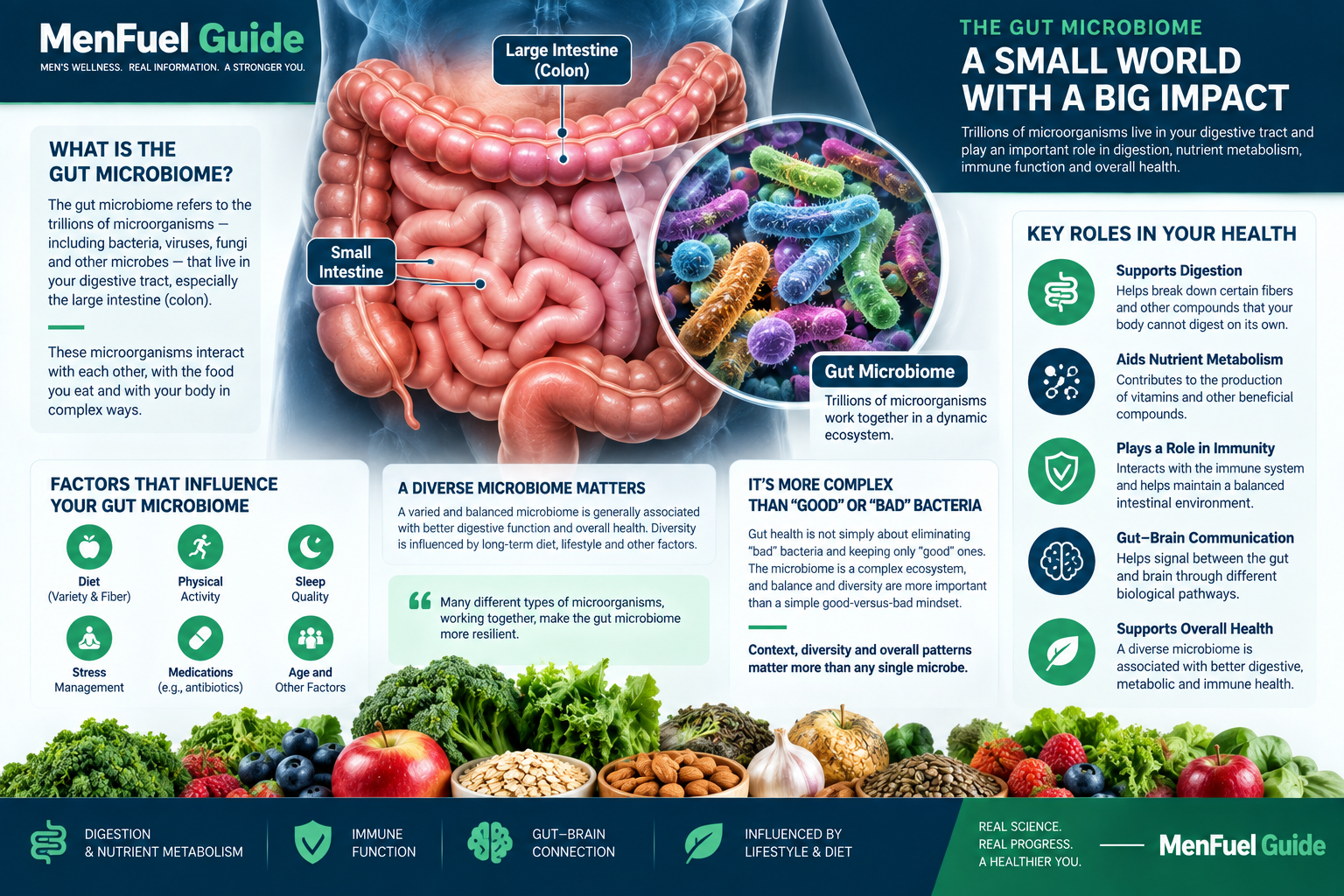
Educational infographic showing the gut microbiome, intestines and microorganisms in the digestive tract
The gut microbiome is a complex ecosystem of microorganisms living throughout the digestive tract.
WHY IT MATTERS

The Microbiome Interacts With Multiple Body Systems

Research on the human microbiome continues to develop. Several established areas help explain why the intestinal microbial community receives so much scientific attention.

01

Digestion & Fermentation

Intestinal microorganisms can metabolize certain dietary components that human digestive enzymes do not completely break down, including some types of dietary fiber.

02

Nutrient Metabolism

Microbial activity contributes to the metabolism of dietary compounds and the production of certain metabolites within the intestinal environment.

03

Immune Interaction

The intestinal microbiota interacts extensively with immune tissues and contributes to the complex relationship between the intestinal environment and immune function.

04

Intestinal Environment

Microorganisms exist alongside the intestinal barrier, mucus layer, immune cells and other components that help maintain the gastrointestinal environment.

05

Gut–Brain Communication

The digestive tract and brain communicate through neural, hormonal, immune and metabolic pathways. Microbial metabolites are one area being studied within this broader gut–brain relationship.

06

Broader Health Research

Researchers continue to investigate relationships between microbiome patterns and many areas of health, but an association does not automatically prove that a particular microbial pattern causes a specific outcome.

WHERE THEY LIVE

Microbial Communities Differ Across the Digestive Tract

The gastrointestinal tract is not one uniform environment. Acidity, oxygen exposure, digestive secretions, transit and available nutrients vary from one region to another.

01 Stomach

Its acidic environment creates different conditions for microbial survival than those found farther along the digestive tract.

02 Small Intestine

Digestion and nutrient absorption are highly active here, creating an environment different from the colon.

03 Large Intestine

The colon contains particularly dense microbial communities and is a major location for microbial fermentation of dietary substrates.

04 Individual Variation

Microbial composition differs between people and can also change within the same person over time.

DIVERSITY & CONTEXT

There Is No Single “Perfect” Gut Microbiome

Microbiome research often examines diversity, stability, microbial functions and the relative abundance of different organisms. But healthy people do not all share one identical microbial profile.

Diversity Can Be Informative—but It Is Not a Standalone Diagnosis

A microbiome result should not be interpreted as a complete measure of digestive health simply because it reports more or fewer types of microorganisms.

!
AVOID THE OVERSIMPLIFICATION

Gut Health Is More Complex Than “Good” vs. “Bad” Bacteria

Microorganisms behave within an ecosystem. Their effects can depend on species, strain, abundance, location, surrounding microbes, diet and the health context of the individual.

A microorganism cannot always be classified as universally “good” or universally “bad” without considering context.
A DYNAMIC ECOSYSTEM

What Can Influence the Gut Microbiome?

Microbial communities can change over time. Diet is important, but it is only one part of a much broader picture.

01 Diet & Fiber

The foods reaching the digestive tract provide different substrates for microbial metabolism.

02 Medications

Some medications, particularly antibiotics, can alter intestinal microbial communities.

03 Age

The microbiome develops and changes across different stages of life.

04 Environment

Geography, exposures and living environment can contribute to differences between individuals.

05 Health Context

Illness, gastrointestinal conditions and other health circumstances may coincide with microbiome changes.

06 Lifestyle

Physical activity, sleep, stress and other behaviors may interact with the broader gut-health environment.

PRODUCT & MARKETING CONTEXT

“Supports the Microbiome” Is Not the Same as Proven Clinical Benefit

Foods, supplements and commercial microbiome products may use terms such as gut friendly, microbiome support or probiotic support. These phrases should not be treated as proof that a product produces a specific health outcome.

01 Marketing Claim
≠
02 Microbiome Change
≠
03 Clinical Benefit
FROM MICROBIOME TO NUTRITION

Food Provides Substrates for the Gut Ecosystem

Certain fibers and other dietary compounds reach the lower digestive tract, where intestinal microorganisms can use them as substrates. This is where the distinction between fiber, prebiotics and probiotics becomes especially important.

Diet → Fiber & Other Substrates → Microbial Metabolism → Microbial Metabolites
MENFUEL GUIDE TAKEAWAY Think Ecosystem, Not Miracle Microbe

The gut microbiome is diverse, dynamic and influenced by many factors. No single bacterium, food or supplement represents the entire ecosystem, and microbiome-related claims should always be interpreted in the context of the specific evidence.

FOOD • FIBER • PREBIOTICS

Fiber, Prebiotics & Gut-Friendly Foods

A gut-supportive eating pattern starts with food. Vegetables, fruits, whole grains, legumes, nuts and seeds can provide dietary fiber and a wide range of nutrients and plant compounds that contribute to the broader digestive environment.

START WITH THE DIET

Feed the Digestive System Before Focusing on Supplements

Food influences digestive health in several ways. It provides nutrients for the body, adds bulk to the digestive contents and supplies compounds that can interact with microorganisms living in the gastrointestinal tract.

Fiber deserves particular attention because human digestive enzymes do not fully digest it. Different types of fiber behave differently in the gastrointestinal tract, and some can be fermented by intestinal microorganisms.

MENFUEL GUIDE PRINCIPLE Food Pattern First. Individual Ingredient Second.

One “gut-friendly” food cannot compensate for an otherwise poor dietary pattern. Variety, consistency and the broader diet matter.

Fiber, prebiotics and gut-friendly foods including vegetables, fruits, whole grains, legumes, nuts and seeds
A varied food pattern can provide different fibers, nutrients and plant compounds that support the broader digestive environment.
IMPORTANT DISTINCTION

Fiber, Prebiotics & Probiotics Are Not the Same Thing

These terms are often grouped together in gut-health marketing, but they describe different things.

01
DIETARY COMPONENT

Fiber

Dietary fiber includes carbohydrates and related components in plant foods that are not fully digested by human digestive enzymes.

Many plant foods provide fiber.
02
MICROBIAL SUBSTRATE

Prebiotics

Prebiotics are specific substrates that are selectively used by host microorganisms and are associated with a health benefit.

Not every type of fiber is automatically a prebiotic.
03
LIVE MICROORGANISMS

Probiotics

Probiotics are live microorganisms that provide a health benefit when administered in adequate amounts.

A probiotic is not simply another name for fiber.
Fiber ≠ Prebiotic ≠ Probiotic
BUILD DIETARY VARIETY

Food Groups That Can Contribute Fiber

Instead of searching for one “best” gut-health food, build variety across several plant-food categories.

01

Vegetables

Include a variety of leafy greens, cruciferous vegetables, root vegetables and other colorful options.

Examples Broccoli • Carrots • Greens • Brussels Sprouts
02

Fruits

Whole fruits can provide fiber along with vitamins, minerals and diverse plant compounds.

Examples Berries • Apples • Pears • Oranges
03

Whole Grains

Whole grains retain more of the original grain structure and can contribute meaningful dietary fiber.

Examples Oats • Barley • Whole Wheat • Brown Rice
04

Beans & Legumes

Legumes combine fiber with plant protein and can make a substantial contribution to overall dietary quality.

Examples Lentils • Chickpeas • Black Beans • Kidney Beans
05

Nuts & Seeds

Nuts and seeds can contribute fiber, unsaturated fats, minerals and other nutrients within a balanced diet.

Examples Almonds • Chia • Flaxseed • Walnuts
06

Plant Variety

Different plant foods contain different fibers and other compounds, making dietary variety more useful than relying heavily on a single “superfood.”

Principle Variety Before Complexity
FIBER HAS MULTIPLE ROLES

Not All Fiber Behaves the Same Way

Fibers differ in characteristics such as solubility, viscosity and fermentability. Those differences affect how they behave in the digestive tract.

01 Stool & Regularity

Certain fibers can contribute bulk or alter stool consistency, supporting normal bowel function.

02 Water Interaction

Some fibers interact strongly with water, which can influence their effects within the digestive tract.

03 Fermentation

Some fibers reach the colon and can be fermented by intestinal microorganisms.

04 Microbial Substrates

Certain dietary compounds can serve as substrates for microorganisms within the gut ecosystem.

INSIDE THE COLON

What Happens When Microorganisms Ferment Fiber?

When fermentable substrates reach the colon, intestinal microorganisms can metabolize them. This microbial activity produces several compounds, including short-chain fatty acids and gases.

This helps explain why dietary fiber is connected to the microbiome—but it also explains why suddenly increasing fermentable foods can sometimes change gas or bloating.

01 Fiber & Substrates
→
02 Reach the Colon
→
03 Microbial Fermentation
→
04 Metabolites & Gas
↑
PRACTICAL GUIDANCE

Increasing Fiber? Give Your Digestive System Time to Adapt

A sudden increase in dietary fiber can cause digestive discomfort for some people. A more gradual increase can make dietary changes easier to tolerate.

Fiber intake should also be considered alongside adequate fluid intake and the individual's overall health context.
WHAT DOES “GUT-FRIENDLY” MEAN?

Treat It as a Practical Description—not a Medical Guarantee

MenFuel Guide uses “gut-friendly foods” as a practical way to describe foods that can fit within a varied, fiber-rich and nutrient-dense dietary pattern.

“Gut-Friendly” ≠ Treats a Digestive Disorder ≠ Guaranteed Symptom Relief
PRACTICAL FOOD-FIRST FRAMEWORK

Build Variety Into Everyday Meals

You do not need an elaborate “microbiome diet.” Start by asking a few simple questions about the meal in front of you.

01 Where Are the Plants?

Include vegetables, fruits or another plant-food source.

02 Where Is the Fiber?

Look for whole grains, legumes, vegetables, fruits, nuts or seeds.

03 Is There Variety?

Rotate food choices rather than eating the same small group of plant foods every day.

04 Is It Sustainable?

A dietary pattern that can be maintained is more useful than a complicated short-term gut-health plan.

FOOD FIRST DOES NOT MEAN “SUPPLEMENTS NEVER”

Supplements Belong Later in the Decision Process

Fiber supplements, prebiotic ingredients and probiotic products may have specific uses, but they should not automatically replace a varied dietary foundation.

Explore the Men's Supplements Guide →
MENFUEL GUIDE TAKEAWAY Build Variety Before Chasing a “Perfect” Gut Food

A varied dietary pattern that includes vegetables, fruits, whole grains, legumes, nuts and seeds can provide multiple types of fiber and other nutrients. The goal is a stronger food foundation—not dependence on one ingredient, superfood or gut-health trend.

DAILY DIGESTIVE FOUNDATIONS

Digestion, Hydration & Daily Habits

Digestive health is shaped by more than individual foods or supplements. Fluid intake, eating patterns, physical activity, sleep, stress and other everyday behaviors can all influence the environment in which digestion takes place.

THE BIGGER PICTURE

Your Digestive System Responds to Your Daily Routine

The gastrointestinal tract is an active system involving muscular movement, digestive secretions, nutrient absorption, water balance and interactions with intestinal microorganisms.

Because these processes occur throughout the day, digestive health should be viewed within the context of overall habits rather than reduced to a single food, ingredient or product.

01 Food
+
02 Fluids
+
03 Movement
+
04 Recovery
+
05 Context
HYDRATION

Water Is Part of Normal Digestive Function

Water participates throughout the digestive process and contributes to normal body function. Fluid needs are individual and can vary with body size, diet, activity, environment and other circumstances.

01 Digestive Contents

Fluids are part of the environment through which food and digestive contents move along the gastrointestinal tract.

02 Fiber & Fluids

When increasing dietary fiber, fluid intake is part of the broader dietary context and should not be overlooked.

03 Water Absorption

Water is absorbed throughout the digestive tract, while the colon plays an important role in recovering water from intestinal contents.

04 Individual Needs

There is no single fluid amount that is ideal for every man in every situation.

H₂O
PRACTICAL PERSPECTIVE Hydration Is Important—but More Water Is Not Always Better

Fluid requirements vary. Exercise, heat exposure, food intake, medical conditions and medications can all change individual needs. The goal is appropriate hydration, not an arbitrary race to consume the largest possible amount of water.

HOW YOU EAT ALSO MATTERS

Everyday Eating Behaviors Can Affect the Digestive Experience

Food choice matters, but portion size, meal pattern and the speed at which you eat can also influence how a meal feels during and after eating.

01

Chew Your Food

Digestion begins in the mouth. Chewing physically breaks food into smaller pieces and mixes it with saliva before swallowing.

02

Consider Portion Size

Very large meals may feel different from smaller meals. Individual tolerance and energy needs should guide the overall eating pattern.

03

Avoid Unnecessary Speed

Slowing down enough to chew and recognize fullness can make eating more deliberate without requiring complicated digestive rules.

04

Notice Your Own Patterns

Foods, portions and meal timing can affect people differently. Repeated patterns are generally more useful than conclusions based on one isolated meal.

MOVEMENT & DIGESTIVE HEALTH

Physical Activity Belongs in the Bigger Health Picture

Regular physical activity supports overall health and is associated with many metabolic and cardiovascular benefits. Movement can also interact with gastrointestinal function, although digestive responses to exercise vary by intensity, duration and individual circumstances.

This is another reason to avoid treating gut health as an isolated system. Exercise, nutrition, hydration and recovery overlap.

MOVE Regular Physical Activity
→
RECOVER Sleep & Rest
→
REFUEL Food & Fluids
SLEEP

Recovery Extends Beyond the Gym

Sleep is part of the broader relationship between daily recovery, metabolism, appetite regulation, stress and overall health.

Gut microbiome research also investigates relationships between sleep patterns and intestinal microbial communities, although these relationships are complex and should not be reduced to claims that one sleep habit will “fix” the gut.

Explore Sleep & Recovery for Men →
STRESS

The Brain and Gut Communicate

The gastrointestinal tract and nervous system communicate through multiple neural, hormonal, immune and metabolic pathways—often discussed collectively as part of the gut–brain axis.

Stress can coincide with changes in digestive sensations and behaviors, but persistent symptoms should not automatically be dismissed as “just stress.”

Stress Context ≠ Explanation for Every Digestive Symptom
A SIMPLE DAILY FRAMEWORK

Six Foundations Before You Chase a Gut-Health Shortcut

These habits are not treatments for digestive disease. They are practical foundations for thinking about digestive wellness within a broader healthy lifestyle.

01 Build Food Variety

Include different plant foods and nutrient-dense choices across the week.

02 Get Enough Fiber

Build fiber intake through vegetables, fruits, whole grains, legumes, nuts and seeds as appropriate.

03 Stay Appropriately Hydrated

Match fluid intake to your individual diet, activity, environment and health context.

04 Keep Moving

Regular physical activity belongs in a comprehensive wellness routine.

05 Protect Sleep

Treat sleep and recovery as health foundations rather than optional extras.

06 Pay Attention to Patterns

Persistent or recurring digestive changes deserve more attention than one isolated reaction to a meal.

KEEP THE BASICS IN PERSPECTIVE

Avoid Turning Healthy Habits Into Absolute Rules

OVERSIMPLIFICATION “Drink More Water and Every Digestive Problem Will Improve.”

Hydration matters, but digestive symptoms can have many different causes.

OVERSIMPLIFICATION “More Fiber Is Always Better.”

Fiber needs, types and tolerance vary. Rapid increases may cause discomfort for some people.

OVERSIMPLIFICATION “Every Digestive Symptom Comes From Stress.”

Stress and digestion can interact, but symptoms should not automatically be assigned a psychological cause.

!
HABITS HAVE LIMITS

Persistent Symptoms Deserve More Than Lifestyle Guesswork

Changes in food, fluids and daily habits can be useful parts of general wellness, but they should not be used to self-diagnose persistent, severe or concerning digestive symptoms.

Digestive Symptom ≠ Diagnosis
MENFUEL GUIDE TAKEAWAY Build the Daily Foundation Before Looking for a Shortcut

Food quality, fiber, appropriate hydration, movement, sleep and stress management belong to the broader digestive-health picture. No single habit guarantees a healthy gut, but together they provide a stronger foundation for informed decisions about symptoms, foods and supplements.

SYMPTOMS • PATTERNS • PROFESSIONAL CARE

Common Digestive Symptoms & When to Seek Care

Bloating, gas, heartburn, constipation, diarrhea, nausea and abdominal discomfort are common experiences—but the same symptom can have many different explanations. Frequency, severity, duration and accompanying warning signs all matter.

START WITH THE RIGHT QUESTION

A Symptom Is Information—not a Diagnosis

Digestive symptoms can occur after changes in food intake, travel, illness, medication use or other everyday circumstances. They can also occur with gastrointestinal conditions that require professional evaluation.

Instead of immediately assigning a cause, pay attention to the pattern: what the symptom feels like, when it occurs, how long it lasts, whether it is becoming more frequent and whether other symptoms appear with it.

MENFUEL GUIDE PRINCIPLE Digestive Symptom ≠ Diagnosis

The presence of bloating, reflux, constipation or another symptom does not by itself identify its underlying cause.

Educational infographic about common digestive symptoms and signs that may require medical evaluation
Digestive symptoms should be considered in context—including severity, duration, recurrence and accompanying warning signs.
COMMON EXPERIENCES

Digestive Symptoms Can Take Many Forms

Symptoms often overlap, which is one reason that self-diagnosis based on a single sensation can be unreliable.

01

Bloating

A sensation of abdominal fullness, pressure or swelling.

02

Gas

Belching or intestinal gas can occur as part of normal digestion but may become bothersome when excessive.

03

Heartburn & Reflux

Burning or discomfort may occur when stomach contents move upward into the esophagus.

04

Constipation

May involve infrequent bowel movements, difficult passage, hard stools or a feeling of incomplete evacuation.

05

Diarrhea

Loose or watery stools may occur temporarily or as part of a longer-lasting digestive problem.

06

Abdominal Discomfort

Pain, pressure or cramping can vary widely in location, intensity and significance.

07

Nausea

The sensation of needing to vomit can occur with many gastrointestinal and non-gastrointestinal conditions.

08

Changes in Bowel Habits

Changes in stool frequency, consistency or appearance can provide useful information when they persist or recur.

LOOK FOR THE PATTERN

Four Questions Can Provide Better Context

One isolated digestive event may tell you very little. Repeated patterns can provide more useful information for deciding whether simple observation or professional evaluation makes sense.

01 How Often?

Occasional, recurring or happening nearly every day?

02 How Severe?

Mild inconvenience or significant pain and disruption?

03 How Long?

Minutes, hours, several days or an ongoing pattern?

04 What Else?

Are there additional symptoms or unusual changes?

MANY POSSIBLE INFLUENCES

Avoid Assuming One Cause Too Quickly

Digestive symptoms may be influenced by multiple factors. These categories provide context—not a diagnostic checklist.

01 Food & Eating Patterns

Meal size, specific foods, fiber intake and sudden dietary changes can alter the digestive experience.

02 Temporary Illness

Gastrointestinal infections and other short-term illnesses can cause digestive symptoms.

03 Medications

Prescription and nonprescription medications can sometimes affect gastrointestinal function.

04 Stress & Daily Routine

Stress, sleep, travel and routine changes can interact with digestive sensations and behaviors.

05 Food Intolerance

Some people experience symptoms related to particular foods, but identifying a true pattern requires more than one reaction.

06 Digestive Conditions

Persistent symptoms can also occur with gastrointestinal disorders that require appropriate clinical evaluation.

USEFUL INFORMATION

What Is Worth Tracking?

When symptoms recur, a simple record can make patterns easier to discuss with a healthcare professional. Avoid turning tracking into an attempt to diagnose yourself.

✓ When the symptom began
✓ How often it occurs
✓ How severe it feels
✓ Food or meals around the episode
✓ Changes in bowel habits
✓ New medications or supplements
!
DO NOT IGNORE WARNING SIGNS

Some Digestive Symptoms Need Prompt Medical Attention

Seek appropriate medical care when digestive symptoms are severe, rapidly worsening or accompanied by concerning signs. The appropriate urgency depends on the situation.

! Severe or Sudden Abdominal Pain
! Vomiting Blood
! Blood in Stool or Black, Tarry Stool
! Persistent or Repeated Vomiting
! Difficulty or Pain With Swallowing
! Unexplained Weight Loss
PERSISTENCE MATTERS

Symptoms Do Not Have to Be an Emergency to Deserve Evaluation

Recurrent or persistent digestive symptoms can still deserve professional attention even when they are not severe enough to require emergency care.

Recurring Symptoms

A symptom repeatedly returning may deserve more attention than a one-time episode.

Changing Pattern

A meaningful change from your usual digestive pattern can be useful information to discuss with a clinician.

Daily-Life Impact

Symptoms that repeatedly interfere with eating, sleeping, work or normal activities deserve attention.

BE CAREFUL WITH ONLINE LABELS

Symptom Matching Is Not the Same as Clinical Diagnosis

Search results and social media can make common symptoms seem highly specific. In reality, bloating, abdominal discomfort, constipation and diarrhea can occur in many different circumstances.

Symptom ≠ Internet Checklist ≠ Diagnosis
BEFORE REACHING FOR A SUPPLEMENT

Match the Product to the Evidence—not the Symptom Alone

Probiotics, prebiotics, fiber products and other digestive supplements are not interchangeable. Evidence can depend on the specific ingredient, strain, dose, population and intended use.

Digestive Symptom ≠ Automatic Supplement Need
Explore Gut Health Supplements →
MENFUEL GUIDE TAKEAWAY Pay Attention to Patterns, Persistence & Warning Signs

Occasional digestive symptoms are common, but symptoms that are severe, persistent, worsening or accompanied by concerning signs should not be managed through guesswork. Understanding the pattern helps support better decisions about self-care and professional evaluation.

Medical Note

This section is for general educational purposes and is not a substitute for diagnosis, treatment or individualized medical advice. Seek qualified medical care for symptoms that are severe, persistent, worsening or otherwise concerning.

PROBIOTICS • PREBIOTICS • SUPPLEMENT DECISIONS

Probiotics, Prebiotics & Gut Health Supplements

Gut-health supplements are often marketed with broad promises, but products can differ substantially in ingredients, microbial strains, doses, formulations and intended uses. Understanding those differences is more useful than choosing a product based on the biggest number or strongest marketing claim.

START WITH THE EVIDENCE

“Gut Health Supplement” Is a Category—not a Single Solution

Probiotic microorganisms, prebiotic ingredients, fiber supplements and other digestive products do not work in the same way. Even products within the same category may have different evidence behind them.

Ingredient ≠ Product ≠ Guaranteed Result
KNOW WHAT YOU ARE BUYING

Three Common Gut-Support Categories

These terms are related, but they should not be treated as interchangeable.

01
LIVE MICROORGANISMS

Probiotics

Probiotics are live microorganisms that provide a health benefit when administered in adequate amounts.

Key Question

Which microorganism and strain was studied for the intended use?

02
MICROBIAL SUBSTRATES

Prebiotics

Prebiotics are substrates selectively used by host microorganisms in ways associated with a health benefit.

Key Question

What specific prebiotic ingredient does the product contain, and in what amount?

03
DIETARY FIBER

Fiber Supplements

Fiber supplements can provide specific types of dietary fiber when additional fiber is appropriate, but different fibers have different physical and physiological properties.

Key Question

What type of fiber is present, and does it match the intended purpose?

Fiber ≠ Prebiotic ≠ Probiotic
PROBIOTIC IDENTITY MATTERS

Genus, Species & Strain Are Not Minor Details

Probiotic research can be strain-specific. Evidence for one microorganism should not automatically be transferred to a different strain simply because the organisms share a similar name.

When evaluating a probiotic label, look beyond a generic phrase such as “probiotic blend.” A more informative label identifies the microorganisms as specifically as possible.

01 GENUS Identity Level
→
02 SPECIES More Specific
→
03 STRAIN Evidence May Be Specific
CFU
DON'T SHOP BY THE BIGGEST NUMBER

More Probiotic CFUs ≠ Better Product

Probiotic labels may report viable microorganisms as colony-forming units, or CFUs. Products can contain millions or billions of CFUs, but a larger number by itself does not establish that a product will provide a greater health benefit.

Strain + Evidence + Appropriate Amount + Intended Use matter more than CFU marketing alone.
READ THE LABEL WITH PURPOSE

Seven Questions Before Choosing a Gut Health Supplement

A useful product evaluation begins with identity and evidence, not testimonials or front-label marketing.

01 What Is the Product?

Probiotic, prebiotic, fiber supplement, combination product or something else?

02 What Exactly Is Inside?

Look for specific ingredients and, for probiotics, clearly identified microorganisms and strains.

03 How Much Does It Provide?

Consider the amount of each relevant ingredient rather than relying only on package language.

04 What Was Actually Studied?

Ingredient evidence does not automatically prove that the finished commercial product has the same effect.

05 What Is the Intended Use?

Evidence for one digestive outcome should not automatically be generalized to every gut-health goal.

06 How Should It Be Stored?

Follow product storage instructions, particularly when the formulation contains live microorganisms.

07 Is It Appropriate for You?

Health conditions, medications and individual circumstances can change the risk-benefit decision.

FOLLOW THE EVIDENCE CHAIN

Do Not Jump From Ingredient Research to Product Promises

A study involving a particular strain or ingredient does not automatically validate every supplement containing something with a similar name.

01 Specific Ingredient or Strain
→
02 Human Research
→
03 Relevant Dose & Population
→
04 Finished Product Evidence?
MARKETING VS. EVIDENCE

Be Careful With Broad “Gut Health” Claims

CLAIM “50 Billion CFUs”

A high CFU number does not by itself demonstrate greater effectiveness.

CLAIM “Multi-Strain Formula”

More strains do not automatically make a product superior. The evidence for the specific formulation matters.

CLAIM “Supports Gut Health”

Broad wording should lead to a more specific question: what outcome is being claimed, and what evidence supports it?

CLAIM “Clinically Studied Ingredients”

Research on an ingredient does not necessarily mean the finished product itself was clinically studied.

!
SAFETY MATTERS

“Natural” or “Probiotic” Does Not Mean Risk-Free for Everyone

Probiotics have a history of use in foods and supplements and are generally well tolerated by many healthy people, but safety depends on the individual and the specific product.

People who are seriously ill, immunocompromised or otherwise medically vulnerable should discuss probiotic use with a qualified healthcare professional. Supplements can also cause gastrointestinal effects such as gas or bloating.

KEEP THE FOUNDATION IN PLACE

Supplements Do Not Replace the Basics

A gut-health supplement should not become a substitute for dietary quality, appropriate fiber intake, hydration, physical activity, sleep or appropriate medical evaluation when symptoms are persistent or concerning.

01 Food Pattern
→
02 Fiber & Fluids
→
03 Daily Habits
→
04 Specific Need
→
05 Supplement?
WHEN PROFESSIONAL INPUT MATTERS

Do Not Use a Supplement to Delay Appropriate Evaluation

If digestive symptoms are persistent, severe, worsening or accompanied by warning signs, choosing another supplement is not a substitute for determining what may be causing the symptoms.

Review Digestive Symptoms & Warning Signs ↑
HOW MENFUEL GUIDE APPROACHES PRODUCTS

Evidence Before Affiliate Commission

When MenFuel Guide evaluates a digestive or gut-health supplement, the commercial relationship should not determine the editorial conclusion.

01 Product Identity
02 Label & Formula
03 Ingredient Evidence
04 Dose Context
05 Safety
06 Transparency
07 Value
08 Editorial Conclusion
See How We Review Supplements →
MENFUEL GUIDE TAKEAWAY Choose the Evidence—not the Biggest Number on the Bottle

Probiotics, prebiotics and fiber supplements can have different roles. For probiotics in particular, the specific microorganism, strain, amount, intended use and supporting evidence matter. A higher CFU count or longer ingredient list does not automatically make one product better than another.

Medical Note

This content is for general educational purposes and does not diagnose, treat or prevent disease. Discuss supplement use with a qualified healthcare professional when you have a medical condition, take medications, have persistent digestive symptoms or have concerns about whether a product is appropriate for you.

COMMON QUESTIONS • EVIDENCE-BASED ANSWERS

Digestive & Gut Health for Men: Frequently Asked Questions

Gut health is often discussed through simplified rules, supplement claims and microbiome trends. These answers focus on practical distinctions supported by established digestive health and nutrition guidance.

01 What does “gut health” actually mean?

“Gut health” is a broad, non-diagnostic term commonly used to describe aspects of gastrointestinal function, digestion, bowel habits and the intestinal environment.

The digestive system itself includes the gastrointestinal tract as well as organs such as the liver, pancreas and gallbladder. Digestion involves movement of food, chemical breakdown, nutrient absorption, water absorption and elimination of waste.

Gut health is broader than the microbiome alone.
02 What is the gut microbiome?

The gastrointestinal tract contains communities of microorganisms that interact with the digestive environment. The terms gut microbiota and gut microbiome are often used in discussions of these microbial communities, although technically they do not mean exactly the same thing.

Research continues to investigate how microbial communities, diet, metabolism, immunity and other aspects of human health interact.

There is no single commercially defined “perfect microbiome” that every man needs to achieve.
03 What foods support digestive and gut health?

A food-first pattern can include vegetables, fruits, whole grains, legumes, nuts and seeds. These foods can provide dietary fiber along with vitamins, minerals and other dietary compounds.

Different plant foods contain different types of fiber and other components, which is one reason dietary variety is generally more useful than depending on one “gut-health superfood.”

Think dietary pattern and variety—not one miracle food.
04 Are fiber and prebiotics the same thing?

No. Dietary fiber is a broad category of dietary components that are not fully digested by human digestive enzymes. Different fibers have different properties, including differences in solubility, viscosity and fermentability.

Prebiotics are more specifically defined by their selective utilization by host microorganisms and an associated health benefit.

Fiber ≠ Prebiotic ≠ Probiotic
05 Do all men need a probiotic supplement?

No general rule says that every healthy man needs a probiotic supplement. Probiotic effects can depend on the specific microorganism, strain, dose, formulation, intended use and population studied.

Evidence supporting one probiotic strain for a particular purpose should not automatically be transferred to every product marketed as a probiotic.

Probiotic category ≠ proven benefit for every person or use.
06 Is a probiotic with more CFUs automatically better?

No. CFU means colony-forming unit and is used to indicate viable microorganisms in probiotic products. A higher CFU number does not by itself demonstrate that one probiotic will be more effective than another.

The identity of the microorganism, strain, studied amount, formulation and intended use provide more meaningful context.

More Probiotic CFUs ≠ Better Product
07 Can increasing fiber cause gas or bloating?

Increasing fiber—particularly fermentable fiber—can change gastrointestinal sensations in some people. Intestinal microorganisms can ferment certain dietary substrates, producing metabolites as well as gases.

When increasing fiber intake, doing so gradually can help the digestive system adapt. Fluid intake should also be considered as part of the broader dietary context.

More fiber is not automatically better if the increase is poorly tolerated.
08 How important is hydration for digestion?

Water is involved throughout normal digestive function. The small and large intestines participate in water movement and absorption, and adequate fluid intake is also relevant when consuming dietary fiber.

Individual fluid needs vary with diet, physical activity, environment, body size, health conditions and other factors.

Appropriate hydration matters; consuming the largest possible amount of water is not the goal.
09 Are occasional digestive symptoms normal?

Gas, bloating, changes in bowel habits and other digestive symptoms can occur occasionally for many reasons. A symptom by itself does not establish a diagnosis.

Frequency, duration, severity, recurrence and accompanying symptoms provide important context. Persistent or worsening symptoms deserve more attention than an isolated episode.

Digestive Symptom ≠ Diagnosis
10 When should I seek medical care for digestive symptoms?

Seek appropriate medical care when symptoms are severe, persistent, worsening or accompanied by concerning signs. Examples that can warrant prompt evaluation include severe abdominal pain, blood in the stool, black or tarry stools, persistent vomiting, difficulty swallowing or unexplained weight loss.

The appropriate urgency depends on the specific symptoms and circumstances. Digestive supplements should not be used to delay necessary medical evaluation.

Persistent or concerning symptoms deserve professional evaluation—not supplement guesswork.
SCIENTIFIC & INSTITUTIONAL REFERENCES

Sources Behind This Guide

MenFuel Guide prioritizes government health agencies, scientific institutions and evidence-based resources when developing educational content about digestive health, nutrition and supplements.

EDITORIAL TRANSPARENCY

How MenFuel Guide Uses Scientific Sources

Institutional guidance helps establish the foundation of our educational content. When evaluating individual ingredients or supplements, we also consider the specific ingredient, dose, formulation, population and relevant human research rather than relying on broad category claims.

Medical Disclaimer

MenFuel Guide provides general educational information and does not provide individualized medical diagnosis or treatment. Digestive symptoms can have many causes. Seek qualified medical care for symptoms that are severe, persistent, worsening or otherwise concerning.

Read the Full Medical Disclaimer →
CONTINUE YOUR MEN'S WELLNESS JOURNEY

Explore More from MenFuel Guide

Digestive health connects with nutrition, sleep, recovery, energy and supplement decisions. Continue with the guide that best matches what you want to understand next.

MENFUEL GUIDE LEARNING PATH

Build the Foundation Before Evaluating Products

Better supplement decisions start with understanding the health goal, the nutritional foundation and the evidence behind the ingredient.

01 Understand the Goal
→
02 Build the Foundation
→
03 Study the Ingredient
→
04 Evaluate the Product
→
05 Make an Informed Choice
MEN'S NUTRITION • WELLNESS • PERFORMANCE

Better Decisions Start With Better Information

MenFuel Guide is building an evidence-informed library to help men understand nutrition, wellness, performance, ingredients and supplements without relying on hype, shortcuts or guaranteed-result claims.

✓ Evidence-Informed
✓ Food First
✓ Transparent Reviews
✓ Responsible Supplement Guidance
OUR EDITORIAL APPROACH Education Before Promotion

We separate general health education, ingredient evidence and finished-product evaluation so readers can better understand what the research actually supports.

Ingredient Evidence ≠ Product Evidence
Supplement ≠ Guaranteed Result
Affiliate Relationship ≠ Editorial Endorsement
Read Our Editorial Policy →
Educational Information

MenFuel Guide provides general educational information and does not provide individualized medical diagnosis, treatment or medical advice.

Affiliate Transparency

Some future links may be affiliate links. Editorial standards and product evaluations are intended to remain separate from affiliate compensation.

Rolar para cima