CoQ10 for Men
Benefits, Dosage, Energy, Heart Health, Ubiquinol & Safety
An evidence-informed guide to coenzyme Q10, including how it works, common supplement forms, dosage context, cardiovascular and performance research, male fertility evidence, side effects and safety.
Important Biological Role ≠ Proven Supplement Benefit for Every Goal
Quick Navigation
Use this guide to understand what CoQ10 is, how the body uses it, common supplement forms, dosage context, food sources, research evidence and important safety considerations.
The Essentials Before We Examine the Evidence
Coenzyme Q10 is naturally produced by the human body and participates in mitochondrial energy metabolism. It also exists in oxidized and reduced forms that can convert between one another.
Coenzyme Q10
A naturally occurring, fat-soluble compound found throughout the body and commonly abbreviated as CoQ10.
Mitochondrial Energy
CoQ10 participates in the mitochondrial electron transport chain involved in cellular ATP production.
Ubiquinone & Ubiquinol
Ubiquinone is the oxidized form and ubiquinol is the reduced form. The body can convert between them.
Formulation Matters
CoQ10 is poorly water-soluble, so formulation and meal context can influence how much is absorbed.
Why Is CoQ10 Associated With Energy?
CoQ10 participates in the mitochondrial electron transport chain, a central part of the process cells use to produce ATP. ATP is the immediate energy currency used for cellular work.
This biological role explains why CoQ10 is frequently marketed for “energy.” But supporting normal cellular energy metabolism is not the same as producing an immediate stimulant-like effect.
A nutrient or compound can play an important role in normal physiology without supplemental amounts automatically creating an immediate or noticeable performance effect.
Your Body Is Not Dependent on Supplements for CoQ10
Humans synthesize CoQ10 naturally as part of normal physiology.
Foods such as meat, fish and some plant foods contribute additional dietary CoQ10.
Supplements provide additional CoQ10 in formulations containing ubiquinone, ubiquinol or related preparations.
Ubiquinone vs Ubiquinol
Supplement labels commonly identify CoQ10 as either ubiquinone or ubiquinol. These are oxidized and reduced forms of CoQ10 rather than completely unrelated ingredients.
Some studies and formulations report higher systemic bioavailability with ubiquinol, but absorption can also be influenced by formulation and individual variability. Higher bioavailability alone does not prove superior outcomes for every health or performance goal.
Compare CoQ10 Forms →CoQ10 Does Not Have One Universal Supplement Dose
Research protocols use different amounts depending on the population, formulation and outcome being studied. A dose used in a clinical trial should not automatically be interpreted as the ideal daily amount for every healthy adult.
Bioavailability is important, but meaningful supplement evaluation also requires evidence that a formulation improves the outcome being claimed.
What Is CoQ10 & How Does It Work?
Coenzyme Q10 is a naturally occurring, fat-soluble compound found throughout the human body. Its best-established biological roles involve mitochondrial energy production and antioxidant activity.
Coenzyme Q10 Is Made Naturally by the Human Body
Coenzyme Q10, commonly shortened to CoQ10, is synthesized naturally in the body and is present in cellular membranes.
The name “ubiquinone” reflects its widespread presence in biological tissues. In humans, the predominant coenzyme Q molecule contains a chain of ten isoprenoid units—hence the name CoQ10.
CoQ10 is especially important inside mitochondria, the cellular structures responsible for much of the body's aerobic energy production.
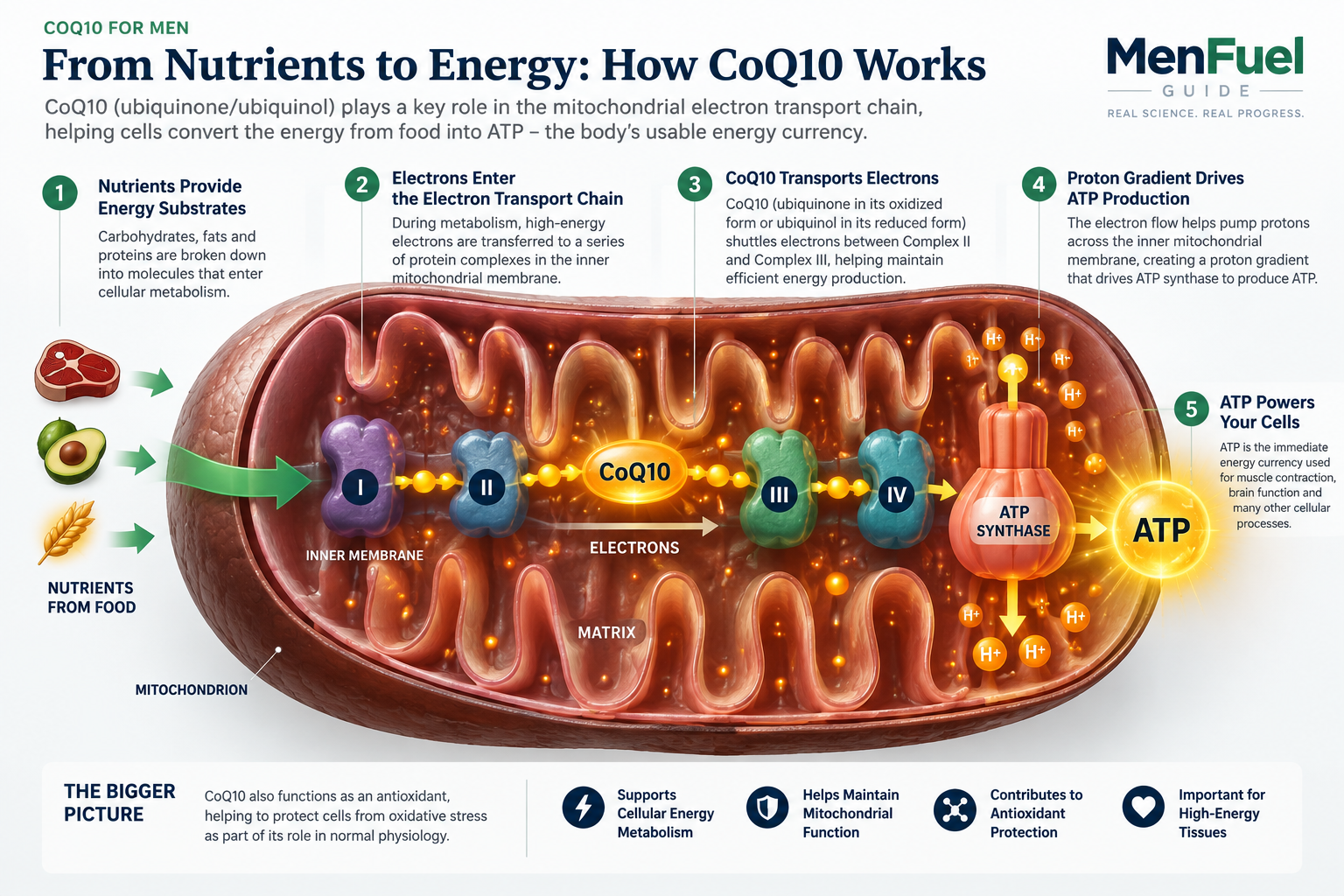
Why CoQ10 Matters for ATP Production
To understand CoQ10, it helps to understand the mitochondria. Nutrients from food are processed through metabolic pathways that ultimately provide high-energy electrons to the mitochondrial electron transport chain.
Carbohydrates, fats and proteins provide energy substrates.
Metabolic pathways generate electron carriers used by mitochondria.
CoQ10 carries electrons within the inner mitochondrial membrane.
The resulting proton gradient helps drive ATP synthase.
CoQ10 Acts as a Mobile Electron Carrier
The mitochondrial electron transport chain contains several protein complexes embedded in the inner mitochondrial membrane. CoQ10 is one of the mobile components connecting parts of this system.
CoQ10 accepts electrons associated with several metabolic pathways, including electron flow through Complex I and Complex II, and transfers those electrons to Complex III.
Electron transport helps support proton movement across the inner mitochondrial membrane. The resulting electrochemical gradient is then used by ATP synthase to produce ATP.
CoQ10's biochemical role in mitochondrial energy metabolism should not be confused with the acute stimulating effects associated with compounds such as caffeine.
What Does ATP Actually Do?
Adenosine triphosphate (ATP) is often described as the cell's immediate energy currency. Cells continually use and regenerate ATP to support biological work.
ATP is required for the molecular processes involved in muscular contraction and relaxation.
Cells use energy to maintain gradients and move substances across membranes.
Building and maintaining cellular structures requires continuous energy input.
ATP supports numerous energy-dependent processes throughout human physiology.
CoQ10 Is More Than an Electron Carrier
CoQ10 also participates in antioxidant defense. This role is particularly associated with its reduced form, ubiquinol.
In biological membranes, reduced CoQ10 can help limit lipid peroxidation and contribute to protection against oxidative damage.
Ubiquinone and Ubiquinol Are Interconvertible Forms of CoQ10
The oxidized form commonly found in CoQ10 supplements and involved in the CoQ redox cycle.
The reduced form of CoQ10, particularly relevant to its antioxidant activity.
The body can convert between these forms. Supplement form, formulation, meal context and individual factors can influence systemic exposure after oral supplementation.
Biological Importance Does Not Automatically Prove a Supplement Benefit
This is a well-established physiological function.
This requires separate human clinical evidence for the population and outcome being claimed.
Four Claims That Should Not Be Treated as Equivalent
Describes its normal biological role in mitochondrial energy metabolism.
A broader outcome claim that requires human evidence and depends on population and context.
An outcome-specific claim that must be evaluated using controlled exercise studies.
Too broad without identifying the cardiovascular outcome, population and clinical context being studied.
Where CoQ10 Fits Into the Energy Pathway
CoQ10 is an important part of this system—but supplementation is only one potential way to alter CoQ10 exposure. Whether additional CoQ10 improves a meaningful outcome depends on the specific research question.
CoQ10 Food Sources & Natural Body Production
CoQ10 comes from two main sources: your body produces it naturally, and smaller amounts come from food. Meat, organ meats and certain fish tend to provide more CoQ10 than most plant foods, but diet is only one part of the body's overall CoQ10 supply.
Unlike an essential nutrient that must be obtained entirely from the diet, CoQ10 is also synthesized within the human body.
Your CoQ10 Supply Is Not Just About Supplements
Discussions about CoQ10 often begin with capsules and softgels, but supplementation is only one potential source. Under normal physiology, endogenous production is an important contributor, while food provides additional dietary CoQ10.
Human cells synthesize CoQ10 through a multistep biochemical pathway.
Animal and plant foods provide varying amounts of naturally occurring CoQ10.
Supplements provide additional CoQ10 in concentrated oral doses.
Which Foods Naturally Contain CoQ10?
CoQ10 occurs naturally in many foods. Animal tissues generally provide more than most fruits, vegetables and grains, although actual concentrations vary by food type, tissue, processing, preparation and analytical method.
Heart, liver and other metabolically active animal tissues can contain meaningful concentrations of CoQ10.
Muscle meats provide naturally occurring CoQ10, although concentrations vary between cuts and species.
Fish such as sardines, mackerel and salmon can contribute dietary CoQ10.
Chicken and eggs contain CoQ10, generally in more modest quantities than the richest organ-meat sources.
Certain nuts, seeds and plant oils can contribute smaller amounts to overall dietary intake.
Foods such as broccoli and spinach contain CoQ10, but usually at lower concentrations than richer animal sources.
This is a broad pattern rather than a precise ranking. CoQ10 concentration varies between individual foods and preparation methods.
The Human Body Can Make CoQ10
CoQ10 is synthesized through a complex pathway that produces both the quinone portion of the molecule and its long isoprenoid side chain.
This endogenous synthesis is one reason CoQ10 should not be treated exactly like an essential vitamin that must be supplied entirely by food.
Why Are High-Energy Tissues Often Discussed With CoQ10?
CoQ10 is present throughout the body, but interest often centers on tissues with substantial mitochondrial activity and continuous energy demands.
Cardiac muscle requires continuous ATP production to sustain contraction throughout life.
Muscle energy requirements rise substantially during physical activity.
The liver performs numerous energy-dependent metabolic and biosynthetic functions.
Renal physiology involves substantial energy requirements, including active transport processes.
Neural tissue has high energy demands and depends heavily on mitochondrial metabolism.
High mitochondrial activity provides a biological reason to study CoQ10 in particular tissues. It does not, by itself, demonstrate that supplementation improves a health or performance outcome.
Dietary CoQ10 and Supplement Doses Are Different Contexts
A normal diet contains CoQ10 distributed across multiple foods. Supplements, by contrast, can deliver concentrated amounts in a single serving.
Dietary CoQ10
Relatively Small AmountsObtained as part of foods that also provide protein, fats, vitamins, minerals and other nutrients.
Concentrated CoQ10
Tens to Hundreds of MilligramsSupplements can provide substantially more CoQ10 than typical amounts obtained from individual foods.
Can You Get CoQ10 From Food Instead of a Supplement?
Yes, food naturally contributes CoQ10 to the diet. But this question should be separated from whether someone is trying to reproduce the concentrated doses used in a particular clinical study.
Eating CoQ10-containing foods can be part of a nutrient-dense diet. It should not be assumed that ordinary food intake will reproduce the exposure produced by a concentrated supplement.
RESEARCH-DOSE QUESTION Does normal food intake equal a concentrated supplement dose? NOT NECESSARILY
Do Not Treat Food CoQ10 Values as Exact Constants
Published food-composition values are useful for identifying richer and poorer dietary sources, but the exact concentration in a meal can vary.
Different animals and plants contain different concentrations.
Organ tissue and skeletal muscle can differ substantially.
Storage and industrial processing can affect measured values.
Preparation method may influence the final amount in food.
Analytical methods and samples can produce different estimates.
Avoid the Simplistic “CoQ10 Falls After 40” Claim
Tissue CoQ10 concentrations can differ with age, tissue type, health status and other biological factors. However, this does not support a universal rule that every man reaches a specific age and suddenly needs CoQ10 supplementation.
Think About the Whole Diet, Not Just One Molecule
Choosing foods solely because they contain CoQ10 misses the larger nutritional picture. Overall dietary quality remains more important than maximizing one naturally occurring compound.
CoQ10 Comes From Both the Body and the Diet
The body synthesizes CoQ10 naturally, while foods provide additional amounts. Organ meats, meats and certain fish tend to be richer dietary sources, with smaller amounts present in many other foods. Supplements represent a separate, concentrated source and should not be confused with normal dietary exposure.
Ubiquinone vs Ubiquinol: What's the Difference?
Most CoQ10 supplements contain either ubiquinone or ubiquinol. They are not two unrelated ingredients—they are oxidized and reduced forms of CoQ10 that participate in the same biological redox cycle.
Form matters, but it is only part of the picture. Formulation, dose, individual absorption and clinical evidence also matter when comparing CoQ10 products.
```A supplement that produces higher circulating CoQ10 levels does not automatically produce greater improvements in energy, cardiovascular health, exercise performance or another outcome.
```Ubiquinone and Ubiquinol Are Interconvertible
CoQ10 repeatedly changes oxidation state as part of its normal biological function. Ubiquinone can accept electrons and become ubiquinol, while ubiquinol can donate electrons and return to an oxidized state.
Ubiquinone
The oxidized form of CoQ10. Ubiquinone has a long history of use in supplements and clinical research.
- Oxidized form
- Widely available
- Extensively studied
- Available in multiple delivery systems
Ubiquinol
The reduced form of CoQ10. Ubiquinol is particularly relevant to CoQ10's antioxidant functions.
- Reduced form
- Antioxidant role
- Available in stabilized supplements
- Studied for oral bioavailability
“Active” vs “Inactive” Is an Oversimplification
Ubiquinol is sometimes marketed as the “active” form of CoQ10. That description can be misleading because normal CoQ10 biology depends on cycling between its oxidized and reduced states.
Ubiquinone therefore should not be interpreted as an inactive ingredient simply because it is the oxidized form.
Both states are part of normal CoQ10 redox biology.
Ubiquinone vs Ubiquinol at a Glance
| Feature | Ubiquinone | Ubiquinol |
|---|---|---|
| Redox State | Oxidized | Reduced |
| Relationship | Interconvertible forms within the CoQ10 redox system | |
| Research History | Extensive | Growing |
| Antioxidant Context | Participates in the redox cycle | Reduced form directly associated with antioxidant activity |
| Absorption | Highly dependent on formulation | Highly dependent on formulation |
| Clinical Superiority? | Not established universally | Not established universally |
Why CoQ10 Absorption Depends on More Than the Form
CoQ10 is lipid-soluble and has relatively limited oral bioavailability. How a product is formulated can substantially affect the amount of CoQ10 reaching the circulation.
Ubiquinone and ubiquinol can behave differently in particular pharmacokinetic comparisons.
Oils, emulsions and other delivery technologies can influence dispersion and absorption.
The physical state and dispersion of CoQ10 can influence bioavailability.
Because CoQ10 is lipid-soluble, administration with food is commonly considered.
People can show substantially different plasma responses to the same formulation.
100 mg Is Not the Whole Story
Two supplements may contain the same labeled amount of CoQ10 while using different forms and delivery technologies. Equal milligrams therefore do not guarantee identical systemic exposure.
Is Ubiquinol Always Better Absorbed?
The evidence is more nuanced than many supplement advertisements suggest. Some comparative studies have found greater systemic exposure from particular ubiquinol preparations, while formulation research also shows that appropriately formulated ubiquinone can achieve substantial bioavailability.
Results from one formulation should not automatically be generalized to every supplement containing the same form of CoQ10.
Some human comparisons report greater circulating CoQ10 exposure from specific ubiquinol preparations.
Well-designed ubiquinone delivery systems can substantially improve oral bioavailability.
The same product and dose can produce different responses among different people.
Higher Blood CoQ10 Is Not the Final Clinical Question
Bioavailability studies answer whether a formulation increases systemic CoQ10 exposure. Clinical trials ask a different question: whether supplementation meaningfully changes a health or performance outcome.
Evidence at one step does not automatically establish an effect at every later step.
```Pharmacokinetic superiority and clinical superiority are different claims and require different evidence.
```CoQ10 Products Can Use Different Delivery Strategies
Because oral absorption can be challenging, manufacturers use different approaches to improve dispersion and bioavailability. These technologies should be evaluated based on evidence rather than marketing terminology alone.
CoQ10 is delivered with a lipid carrier.
Designed to improve dispersion before intestinal absorption.
Delivery systems intended to improve dispersion of the lipid-soluble compound.
Various manufacturing techniques may be used to influence dissolution and bioavailability.
Four CoQ10 Claims Worth Examining More Carefully
This can oversimplify the normal conversion between ubiquinone and ubiquinol.
Check the comparator, formulation, dose and study design behind the number.
A larger dose does not automatically mean better absorption or a greater clinical effect.
A delivery technology can be useful, but the phrase itself is not clinical evidence.
How to Compare CoQ10 Supplements More Rationally
Instead of selecting a supplement based only on whether the label says ubiquinone or ubiquinol, evaluate the complete product.
Form Is Only the Beginning of the Comparison
Ubiquinol Is Not Automatically the Better Choice
Ubiquinone and ubiquinol are interconvertible forms of CoQ10. Some ubiquinol formulations have demonstrated strong bioavailability, but formulation characteristics can substantially influence absorption for either form.
The more useful comparison is therefore form + formulation + dose + evidence + safety + cost, rather than choosing a product based on the form name alone.
```What Does CoQ10 Actually Do for Men?
CoQ10 is essential to mitochondrial energy metabolism and also participates in antioxidant defense. Those biological roles explain why researchers have studied CoQ10 for cardiovascular health, fatigue, exercise performance and male fertility.
But biological importance does not mean that taking additional CoQ10 improves every outcome. The evidence varies substantially depending on the population, health condition and outcome being measured.
```Evidence from people with a diagnosed medical condition should not automatically be applied to healthy men seeking more energy, better workouts or general wellness.
```Not Every CoQ10 Claim Has the Same Level of Support
A useful way to interpret CoQ10 research is to separate condition-specific clinical evidence from broader wellness and performance claims.
Clinical trials and meta-analyses report potentially meaningful effects in some people with heart failure, but this is a medical treatment context—not evidence that CoQ10 prevents heart disease in healthy men.
Meta-analytic evidence suggests that supplementation may reduce fatigue scores in some populations, although the studies include different health contexts, doses and durations.
CoQ10 reliably increases circulating CoQ10, but improvements in endurance, strength and overall exercise performance have been small, inconsistent or unstable across analyses.
Research in men with infertility suggests possible improvements in several semen parameters, but evidence for pregnancy and live-birth outcomes remains much less certain.
CoQ10 and Heart Health
The cardiovascular literature is one of the most clinically significant areas of CoQ10 research, particularly in people who already have heart failure. This evidence needs to remain separate from general cardiovascular prevention claims.
High Cardiac Energy Demand
The heart requires continuous ATP production, providing a biological rationale for studying mitochondrial compounds such as CoQ10 in cardiovascular disease.
Heart Failure
Randomized-trial meta-analyses have reported improvements in several outcomes among people with heart failure receiving CoQ10 alongside usual care.
Not General Prevention Evidence
Results in diagnosed heart-failure populations do not establish that healthy men should take CoQ10 to prevent cardiovascular disease.
The analysis reported lower all-cause mortality and heart-failure hospitalization and improvements in several functional or clinical measures. Evidence quality ranged from low to moderate depending on the outcome.
Does CoQ10 Increase Energy?
“Energy” can mean two very different things. CoQ10 participates in cellular ATP production, while feeling energetic is a subjective human outcome influenced by sleep, health, nutrition, medications, stress and many other factors.
Some Evidence Supports Reduced Fatigue
A systematic review and meta-analysis of randomized controlled trials found a statistically significant reduction in fatigue scores with CoQ10 supplementation compared with placebo.
This is more meaningful than relying on CoQ10's mitochondrial mechanism alone. However, fatigue trials have included different populations and clinical contexts, so the results should not be interpreted as proof that every healthy man will feel more energetic after taking CoQ10.
Does CoQ10 Improve Workout Performance?
CoQ10 has a strong theoretical connection to exercise because muscle contraction requires ATP and intense exercise can increase oxidative stress. Human performance results, however, are much less impressive than the mechanism might suggest.
Blood CoQ10 Increases
Supplementation reliably raises circulating CoQ10 concentrations. This demonstrates absorption and biochemical exposure.
Oxidative Stress & Muscle-Damage Markers
Some meta-analyses report reductions in selected markers of exercise-induced oxidative stress and muscle damage.
Actual Performance
Improvements in endurance, strength and other performance outcomes remain inconsistent and generally modest.
Biochemical Response Was Clearer Than Performance Improvement
A supplement can influence a biochemical pathway without producing a meaningful improvement in strength, endurance or athletic performance.
CoQ10 and Male Fertility
Male fertility is another area where CoQ10 has attracted substantial research interest. Oxidative stress can affect sperm function, and sperm cells have considerable energy requirements for motility.
Most positive fertility evidence comes from men with idiopathic infertility or other subfertility contexts—not from unselected healthy men.
Several trials and pooled analyses suggest that CoQ10 may improve total or progressive sperm motility in some infertile men.
Recent pooled research has also reported improvements in some measures such as total sperm count and normal morphology, although results vary across studies and outcomes.
Improvement in semen analysis does not automatically establish improved pregnancy or live-birth outcomes.
Evidence for an earlier biological or laboratory outcome should not be presented as proof of a later reproductive outcome.
Is CoQ10 a Testosterone Booster?
Some fertility-focused research has reported changes in reproductive hormones, including testosterone. That does not establish CoQ10 as a general testosterone-boosting supplement for healthy men.
Population matters: findings from men undergoing evaluation or treatment for infertility should not be generalized to all men.
The Same Claim Can Mean Very Different Things
Results from one group cannot automatically be transferred to another. This is one of the most important principles when reading supplement research.
```How Strong Are the Major CoQ10 Claims?
Before Believing a CoQ10 Benefit Claim, Ask Four Questions
CoQ10 Evidence Is Highly Context-Dependent
CoQ10 has legitimate biological importance and meaningful clinical research behind it, but the strongest conclusions are not universal. Heart-failure research applies to a specific medical population. Fatigue research is promising but heterogeneous. Exercise-performance benefits remain limited and inconsistent, while male-fertility research suggests improvements in some semen parameters without establishing equivalent certainty for pregnancy or live birth.
CoQ10 Safety, Side Effects & Drug Interactions
CoQ10 is generally well tolerated in human studies, and serious adverse effects have not been commonly reported. That does not mean it is appropriate for everyone or that it cannot interact with medications.
The most important safety questions involve warfarin and anticoagulation, diabetes treatment, blood-pressure medications, cancer treatment, surgery and the complete medication list.
```Supplement safety depends not only on the ingredient itself, but also on medications, health conditions, dose, treatment goals and upcoming medical procedures.
```Is CoQ10 Generally Safe?
Available human research suggests that CoQ10 has a relatively favorable tolerability profile. Reported adverse effects are usually mild rather than severe.
However, safety data from controlled studies should not be interpreted as permission to ignore medication interactions or use increasingly large doses without a clear reason.
Serious adverse effects have not been commonly reported in clinical research.
Gastrointestinal symptoms and sleep-related complaints are among the effects reported with supplementation.
The safety question changes when prescription medications or active medical treatment are involved.
What Side Effects Can CoQ10 Cause?
Reported side effects are generally mild. Not every symptom that occurs during supplementation is necessarily caused by CoQ10, but new or persistent symptoms should still be evaluated in context.
Gastrointestinal discomfort can occur in some users.
Loose stools or digestive upset have been reported.
Appetite suppression has been reported infrequently.
Difficulty sleeping has been reported in some people.
CoQ10 and Warfarin Require Special Attention
CoQ10 has been reported to interact with warfarin. Because warfarin has a narrow therapeutic range, changes in its anticoagulant effect can be clinically important.
A clinician managing anticoagulation should know about CoQ10 use, including when supplementation is started, stopped or substantially changed.
Warfarin Evidence Should Not Be Generalized to Every Anticoagulant
The best-recognized CoQ10 anticoagulation concern involves warfarin. Different anticoagulant and antiplatelet medications work through different mechanisms, so it is not appropriate to assume that every drug has exactly the same interaction.
If you use any prescription anticoagulant or antiplatelet medication, the practical approach is to have the complete medication and supplement combination reviewed rather than assuming compatibility.
```Can CoQ10 Lower Blood Pressure?
Blood-pressure research has produced mixed results over time. Recent pooled randomized-trial evidence suggests that CoQ10 may modestly reduce systolic blood pressure, while effects on diastolic pressure and heart rate appear smaller or less consistent.
This does not make CoQ10 a replacement for prescribed hypertension treatment, but it creates a practical consideration for people who already take medications that lower blood pressure.
CoQ10, Diabetes & Glucose-Lowering Treatment
CoQ10 has been investigated for effects on glycemic control. Meta-analyses of randomized trials suggest that supplementation may produce modest changes in some glucose-related markers, although findings differ across outcomes and study populations.
The practical safety issue is not that CoQ10 should be treated as a diabetes drug. It is that someone already using insulin or other glucose-lowering treatment should avoid assuming that an additional supplement is irrelevant to glucose management.
Pooled research has reported changes in fasting glucose and some other metabolic markers, but results are not identical across analyses.
The U.S. National Center for Complementary and Integrative Health identifies insulin among medications that may interact with CoQ10.
People using diabetes medications should discuss supplement use with the clinician responsible for their glucose management.
Which Medication Situations Deserve Extra Attention?
Potential interaction with anticoagulant therapy. Do not make unsupervised changes to supplementation.
Insulin is specifically identified as a potential interaction, and glucose effects have been studied in clinical trials.
Because CoQ10 may modestly affect systolic pressure, the combined blood-pressure effect deserves consideration.
Antioxidant supplements can raise treatment-specific concerns. CoQ10 use during chemotherapy or radiation therapy should be discussed with the oncology team.
Interaction concerns have also been reported with theophylline. Medication-specific review is appropriate.
The more complex the medication regimen, the more useful a pharmacist or clinician review becomes before adding supplements.
Statins Can Affect CoQ10 Biology—but That Does Not Settle the Supplement Question
Statins are frequently discussed alongside CoQ10 because inhibition of the cholesterol-synthesis pathway can also influence endogenous CoQ10 levels.
That biochemical observation does not automatically prove that everyone taking a statin needs a CoQ10 supplement or that CoQ10 will prevent statin-associated muscle symptoms.
Tell Your Surgical Team About CoQ10
Dietary supplements can matter around surgery because they may interact with medications, anesthesia, blood pressure, anticoagulation or other aspects of perioperative care.
If you have a planned procedure, include CoQ10 when you provide your medication and supplement list to the surgeon, anesthesiology team and other clinicians involved in your care.
List CoQ10 with your other supplements.
Tell the surgical and anesthesia teams.
Follow their instructions about continuing or stopping it.
Do not invent your own stop/restart schedule.
Procedures, medications and individual risk factors differ. The appropriate timing should come from the healthcare team managing the procedure rather than from a generic supplement rule.
```Talk With a Clinician or Pharmacist Before Using CoQ10 If...
You take warfarin or another blood thinner.
You use insulin or diabetes medication.
You take medication for high blood pressure.
You are receiving cancer treatment.
You have an upcoming surgery or procedure.
You use multiple prescription medications.
You are considering CoQ10 for a diagnosed cardiovascular condition.
You develop a persistent or concerning symptom after starting supplementation.
Routine Question or Urgent Medical Problem?
Medication interactions, dose questions, supplement quality and whether CoQ10 fits a specific health goal can usually be discussed during routine care.
Contact a healthcare professional if symptoms appear after starting a supplement and are persistent, significant or concerning.
Seek emergency care for severe symptoms such as difficulty breathing, loss of consciousness, severe allergic symptoms or other signs of a medical emergency.
Before Adding CoQ10, Review the Full Context
CoQ10 occurs naturally in the human body, but concentrated supplementation can still matter in the context of medications and medical treatment.
```CoQ10 Has a Favorable Safety Profile—but Context Matters
CoQ10 is generally well tolerated, with gastrointestinal symptoms, appetite changes and insomnia among the mild adverse effects that have been reported. The more important practical issues often involve medication and treatment context rather than toxicity alone.
Warfarin deserves particular attention. Insulin, blood-pressure treatment, cancer therapy, theophylline and upcoming surgery are additional situations where professional review may be appropriate.
Frequently Asked Questions About CoQ10 for Men
Quick, evidence-informed answers to common questions about CoQ10, including dosage, ubiquinone vs ubiquinol, energy, heart health, exercise, fertility, food sources and safety.
01 What does CoQ10 do in the body? +
Coenzyme Q10 is a naturally occurring compound involved in the mitochondrial electron transport chain, where it helps transfer electrons during ATP production. Its reduced form, ubiquinol, also participates in antioxidant defense.
This biological importance explains why CoQ10 is widely studied, but it does not mean that additional supplementation improves every health or performance outcome.
02 How much CoQ10 should a man take per day? +
There is no established Recommended Dietary Allowance (RDA) or Daily Value (DV) for CoQ10 and no single supplement dose that is appropriate for every man.
Human studies have used a wide range of doses depending on the population, formulation, health condition and outcome being investigated. A research dose should not automatically be treated as a personal dosing recommendation.
03 Is ubiquinol better than ubiquinone? +
Not universally. Ubiquinol is the reduced form of CoQ10 and ubiquinone is the oxidized form. The body can convert between the two.
Some ubiquinol formulations have demonstrated higher systemic exposure than particular ubiquinone formulations, but bioavailability also depends on formulation technology and individual response. Higher blood exposure does not by itself establish superior clinical outcomes.
04 Should CoQ10 be taken with food? +
CoQ10 is lipid-soluble, and oral absorption can be influenced by formulation and meal conditions. Many CoQ10 products are therefore taken with food, particularly a meal containing fat.
The product's directions should also be checked because delivery systems differ between supplements.
05 Does CoQ10 give you more energy? +
CoQ10 participates in mitochondrial ATP production, but it does not work like an acute stimulant such as caffeine.
A meta-analysis of randomized trials found reduced fatigue scores in some studied populations. However, that evidence does not mean that every healthy man will experience a noticeable energy boost from supplementation.
06 Is CoQ10 good for the heart? +
CoQ10 has been extensively investigated in cardiovascular research. Meta-analyses of randomized trials in people with heart failure have reported potentially meaningful benefits for several clinical and functional outcomes when CoQ10 was used in addition to usual care.
Those findings apply to a diagnosed medical population and should not be presented as proof that CoQ10 prevents heart disease in otherwise healthy men.
07 Does CoQ10 lower blood pressure? +
Research on blood pressure has produced mixed findings, and the size and consistency of any effect remain uncertain. CoQ10 should not be used as a replacement for prescribed hypertension treatment.
Men who use blood-pressure medication should include CoQ10 when discussing their supplement regimen with a clinician or pharmacist.
08 Does CoQ10 improve exercise performance? +
CoQ10 supplementation reliably increases circulating CoQ10, but improvements in strength, endurance and overall exercise performance have been limited and inconsistent in controlled research.
CoQ10 therefore should not be treated as equivalent to an ingredient such as creatine, which has a different and more established evidence base for specific performance outcomes.
09 Can CoQ10 improve male fertility? +
Research in men with idiopathic infertility suggests that CoQ10 may improve selected semen parameters, including measures of sperm motility and, in some analyses, sperm concentration, total sperm number or morphology.
Improved semen parameters are not the same as proven improvement in pregnancy or live-birth rates. Those clinically important outcomes remain less certain.
10 Does CoQ10 increase testosterone? +
CoQ10 should not be marketed as a proven general testosterone booster. Some reproductive-health trials have measured testosterone and other hormones, particularly in men with infertility, but those findings cannot automatically be applied to healthy men seeking higher testosterone.
11 What foods contain CoQ10? +
CoQ10 occurs naturally in food. Organ meats, meats and certain fish tend to be richer sources, while poultry, eggs, nuts, seeds, oils and vegetables can contribute smaller or varying amounts.
The body also synthesizes CoQ10 naturally, so food is not the only source.
12 Do men over 40 automatically need CoQ10? +
No. Age can be associated with changes in CoQ10 biology, but there is no universal age threshold at which every man suddenly needs a CoQ10 supplement.
Supplement decisions should consider the intended goal, health status, medications, evidence and individual clinical context rather than age alone.
13 Should men taking statins use CoQ10? +
Statins can influence the biochemical pathway involved in endogenous CoQ10 production, which is why CoQ10 has been studied in relation to statin-associated muscle symptoms.
This does not establish that every statin user needs CoQ10 or that supplementation reliably prevents muscle symptoms. Men with statin-related symptoms should discuss them with the clinician managing the medication rather than changing treatment on their own.
14 What medications can interact with CoQ10? +
Warfarin is an important interaction concern. The U.S. National Center for Complementary and Integrative Health also identifies insulin as a potential interaction and notes that CoQ10 may not be compatible with some cancer treatments.
People using prescription medications—especially complex regimens—should have the complete supplement and medication list reviewed by a clinician or pharmacist.
15 What are the side effects of CoQ10? +
CoQ10 is generally well tolerated. Mild adverse effects such as digestive upset and insomnia have been reported.
Persistent, significant or concerning symptoms should be discussed with a healthcare professional, particularly when other medications or medical conditions are involved.
Research Behind This CoQ10 Guide
MenFuel Guide prioritizes systematic reviews, meta-analyses, randomized controlled trials and established health institutions. References below are organized by the question they help answer.
CoQ10 Biology
Reviews CoQ10 absorption, circulating levels and antioxidant biology and provides foundational context for understanding oral supplementation.
PubMed →Reviews the path from oral ingestion through intestinal absorption, blood transport and metabolism while discussing factors that influence CoQ10 bioavailability.
PubMed →Ubiquinone, Ubiquinol & Bioavailability
A small human study comparing plasma CoQ10 responses after supplementation with the two forms. Useful for bioavailability context, but not proof of superior clinical outcomes.
PubMed →Reviews formulation technologies intended to improve CoQ10 solubility and bioavailability, including lipid-based and other specialized delivery systems.
PubMed →Cardiovascular & Heart Failure Evidence
Included 33 studies and reported effects across mortality, hospitalization, functional and cardiac outcomes in people with heart failure. Evidence quality varied by outcome.
PubMed →U.S. NIH resource summarizing clinical evidence, uncertainties, side effects and recognized interaction concerns.
NCCIH / NIH →Fatigue & Exercise
Analyzed 13 randomized controlled trials involving 1,126 participants and found a statistically significant reduction in fatigue scores compared with placebo.
PubMed →Examined randomized trials in healthy adults. Blood CoQ10 increased consistently, while performance effects were limited, inconsistent and generally supported by lower-certainty evidence.
PubMed →Evaluated controlled trials in athletes and examined markers related to oxidative stress and exercise-induced muscle damage.
PubMed →Male Fertility
Evaluates randomized trials of CoQ10 in idiopathic male infertility, including semen outcomes, dose, formulation, treatment duration and safety.
PubMed →Reviews randomized controlled trials assessing semen quality and male reproductive hormones, helping distinguish fertility research from broad testosterone-marketing claims.
PubMed →Earlier pooled evidence found improvements in several sperm parameters but did not establish increased pregnancy rates, and the included trials did not provide live-birth data.
PubMed →Safety & Interactions
Reports that serious adverse effects have not been commonly reported, while mild digestive effects and insomnia can occur. It also identifies potential interactions with warfarin and insulin and cautions about some cancer-treatment contexts.
NCCIH / NIH →Reviews preclinical and clinical safety data and provides broader historical context for CoQ10 tolerability and dose-related safety evaluation.
PubMed →How MenFuel Uses These References
What does CoQ10 do biologically?
Has the claim been tested in people?
Who was actually studied?
Biomarker, symptom or clinical result?
How strong is the claim?
Research showing an effect from CoQ10 does not automatically validate every commercial CoQ10 supplement. Form, formulation, dose, manufacturing quality and the studied population all matter.
This guide is for educational purposes and is not a substitute for individualized medical advice, diagnosis or treatment. Medication interactions, diagnosed conditions, fertility treatment and cardiovascular care should be discussed with an appropriate healthcare professional.
Keep Exploring Supplement Ingredients
CoQ10 is only one piece of the supplement landscape. Compare it with other evidence-informed MenFuel guides covering minerals, vitamins, fatty acids and performance ingredients.
Explore the Ingredient Library →Start with the goal—not the supplement label.
Compare CoQ10 With Other MenFuel Guides
Strength, muscle, performance, dosage and creatine monohydrate.
Read Guide → FATTY ACIDS Omega-3 for MenEPA, DHA, food sources, triglycerides, fish oil and safety.
Read Guide → MINERAL Magnesium for MenDaily needs, food sources, supplement forms, sleep and exercise.
Read Guide → VITAMIN Vitamin D for MenDaily needs, D2 vs D3, sunlight, food sources and safety.
Read Guide → MINERAL Zinc for MenDaily intake, food sources, forms, fertility and testosterone evidence.
Read Guide →Ashwagandha for Men
The next MenFuel ingredient guide will examine ashwagandha through the same framework: biological rationale, human evidence, dose, extract standardization, stress and performance research, testosterone claims and safety.
Understand the Ingredient Before Choosing the Supplement
MenFuel Guide helps men evaluate supplements by separating biological plausibility, human evidence, dosage, formulation, safety and marketing claims.
