
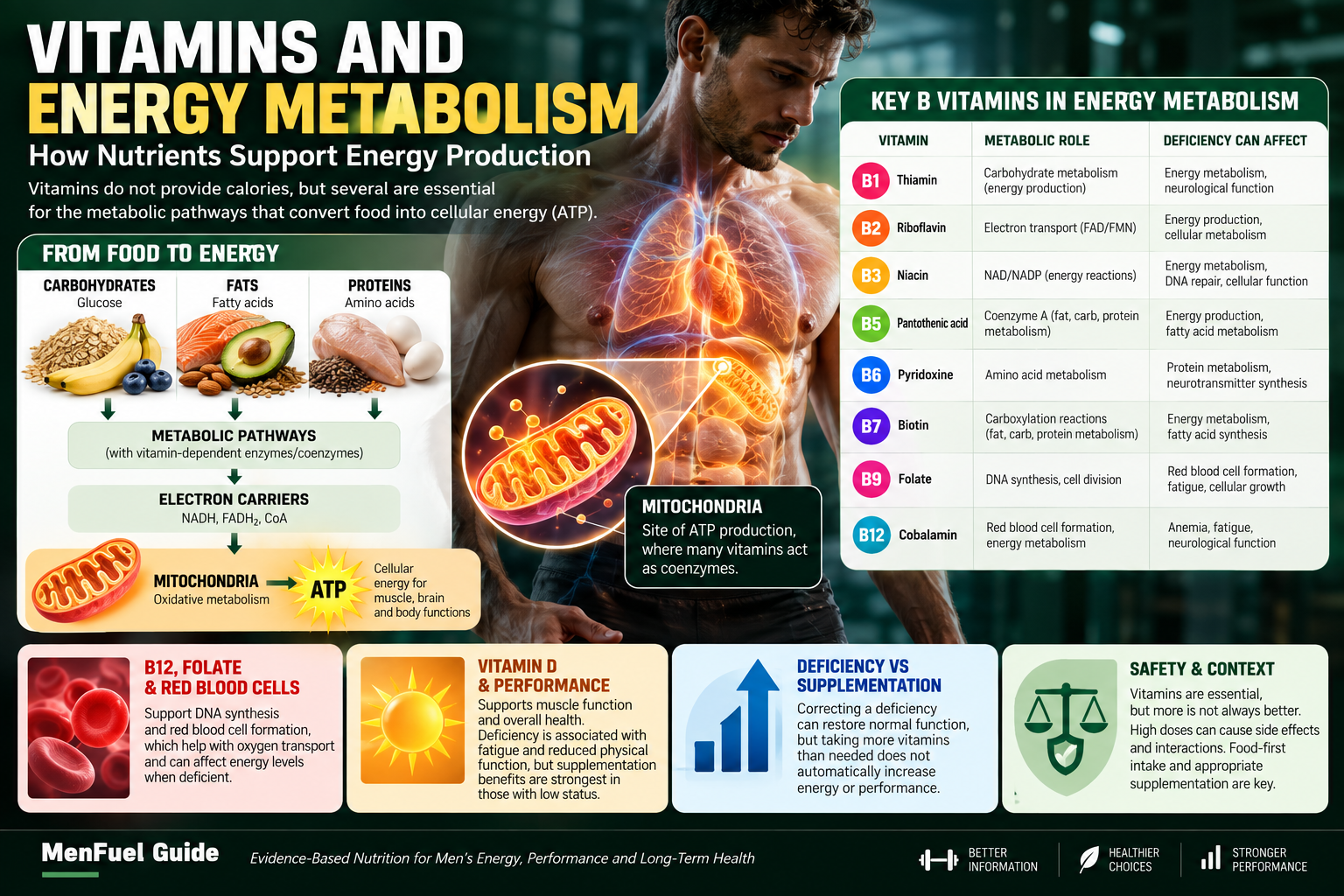
Vitamins and Energy Metabolism: How Nutrients Support Energy Production
Vitamins do not provide calories or energy directly. Instead, several vitamins act as essential cofactors and coenzymes in the metabolic pathways that help the body convert carbohydrates, fats and proteins into usable cellular energy.
Food provides the fuel. Vitamins help the metabolic machinery use it.
Do Vitamins Give You Energy?
Not in the same way that food provides energy. Vitamins contain no meaningful calories, but several are required for the metabolic reactions that allow the body to convert carbohydrate, fat and protein into usable cellular energy.
Food Provides the Fuel
Carbohydrates, fats and proteins provide chemical energy that can be processed through metabolic pathways.
Vitamins Help the Machinery Work
Several vitamins function as parts of coenzymes or support enzyme systems involved in carbohydrate, fat, protein and cellular energy metabolism.
Cells Produce ATP
ATP is the immediate energy currency used to support muscle contraction, cellular work and many other biological processes.
Nutritional Energy and Feeling Energetic Are Not the Same Thing
The word energy is often used in two different ways. In nutrition and physiology, energy refers to the chemical energy obtained from food and ultimately captured in molecules such as ATP. In everyday language, “energy” may describe alertness, motivation, fatigue or how someone feels.
Fuel metabolism, ATP production and the energy required for biological work.
A subjective experience influenced by sleep, nutrition, stress, health, training and many other factors.
Supporting Energy Metabolism ≠ Providing Energy
When a vitamin is described as contributing to normal energy metabolism, this does not mean the vitamin itself supplies calories or acts like a stimulant. It means the nutrient participates in biological processes required for normal metabolism.
Deficiency and Supplementation Are Different Questions
Calories provide energy. Vitamins help support the metabolic systems that process nutrients and maintain normal cellular function. Correcting a deficiency can matter greatly, but taking more of a vitamin when nutritional status is already adequate should not automatically be expected to increase energy or exercise performance.
How the Body Produces Cellular Energy
Energy metabolism is a connected network of reactions. Carbohydrates, fats and proteins enter different pathways, but much of their usable energy ultimately converges on mitochondrial processes that support ATP production.
Macronutrients
These nutrients provide carbon substrates and chemical energy that can enter metabolic pathways.
Metabolic Pathways
Different fuels enter metabolism through different routes, producing acetyl-CoA or other intermediates that can feed central energy-producing pathways.
Acetyl-CoA & Metabolic Intermediates
Acetyl-CoA is a major metabolic junction connecting the breakdown of carbohydrate, fat and some amino acids with the citric acid cycle.
Citric Acid Cycle
The citric acid cycle — also called the TCA or Krebs cycle — oxidizes acetyl-CoA and transfers much of its energy into reduced electron carriers.
Electron Transport Chain
NADH and FADH2 carry high-energy electrons to the mitochondrial electron transport chain. Electron transfer helps establish a proton gradient across the inner mitochondrial membrane.
ATP Production
The proton gradient helps drive ATP synthase, supporting the production of ATP from ADP and inorganic phosphate. ATP can then be used to power muscle contraction and many other forms of cellular work.
They Help Build the Metabolic Machinery
Many B vitamins become components of coenzymes that participate in fuel metabolism, electron transfer and other reactions required for normal cellular energy metabolism.
Supports key reactions connecting carbohydrate metabolism with mitochondrial energy pathways.
Forms flavin coenzymes involved in oxidation-reduction reactions and electron transfer.
Forms coenzymes central to transferring electrons during cellular metabolism.
Is part of coenzyme A, central to acetyl-CoA formation and fuel metabolism.
Supports amino-acid metabolism and other reactions involved in normal nutrient metabolism.
Functions as a cofactor for carboxylase enzymes involved in carbohydrate, fat and amino-acid metabolism.
Vitamins Enable Reactions. They Are Not the Fuel.
B vitamins participate in metabolic systems that help extract and transfer energy from nutrients. This explains why deficiency can interfere with normal metabolism — but it does not mean that taking additional B vitamins automatically increases ATP production or exercise performance when nutritional status is already adequate.
B Vitamins and Energy Metabolism
B vitamins do not provide calories. Their importance comes from their roles as coenzyme components, cofactors or nutrients required for reactions involved in fuel metabolism, blood-cell formation and normal cellular function.
Adequate B-vitamin status helps normal metabolism function. Deficiency can disrupt that function, but more vitamin does not automatically mean more ATP, more energy or better performance.
| Vitamin | Coenzyme / Function | Role in Metabolism | Deficiency May Affect |
|---|---|---|---|
|
B1
Thiamin
Thiamine
|
TPP
Thiamin pyrophosphate |
Supports enzymes involved in carbohydrate metabolism and reactions that connect fuel breakdown with mitochondrial energy pathways. |
Energy metabolism, nervous-system function and cardiovascular function. |
|
B2
Riboflavin
Vitamin B2
|
FAD / FMN
Flavin coenzymes |
Participates in oxidation-reduction reactions and electron transfer involved in carbohydrate, fat and protein metabolism. |
Normal cellular metabolism and tissues with rapid turnover, including skin and mucosal tissues. |
|
B3
Niacin
Vitamin B3
|
NAD / NADP
Electron-transfer coenzymes |
Central to oxidation-reduction reactions that transfer electrons during carbohydrate, fat and protein metabolism. |
Cellular energy metabolism, skin, digestive function and nervous-system function. |
|
B5
Pantothenic Acid
Vitamin B5
|
Coenzyme A
Acyl-group transfer |
Is a component of coenzyme A, which is essential for acetyl-CoA metabolism and the processing of carbohydrate, fat and protein. |
Multiple metabolic processes; isolated deficiency is uncommon because pantothenic acid is widely distributed in food. |
|
B6
Vitamin B6
Pyridoxine family
|
PLP
Pyridoxal phosphate |
Supports amino-acid metabolism, glycogen metabolism, neurotransmitter synthesis and numerous enzyme reactions. |
Hemoglobin-related processes, immune function, neurological function and normal metabolism. |
|
B7
Biotin
Vitamin B7
|
Carboxylases
Enzyme cofactor |
Functions as a cofactor for carboxylase enzymes involved in fatty-acid synthesis, gluconeogenesis and amino-acid metabolism. |
Normal metabolism and neurological or skin-related function; deficiency is uncommon. |
|
B9
Folate
Vitamin B9
|
THF Derivatives
One-carbon transfer |
Supports one-carbon metabolism, DNA synthesis, amino-acid metabolism and normal cell division. |
Red-blood-cell formation and rapidly dividing cells; deficiency can contribute to megaloblastic anemia. |
|
B12
Vitamin B12
Cobalamin
|
Cobalamin Coenzymes
Methyl & rearrangement reactions |
Supports normal red-blood-cell formation, neurological function, DNA synthesis and specific metabolic reactions. |
Red-blood-cell production and neurological function; fatigue and weakness can occur with deficiency. |
Different Vitamins, Different Jobs
Major coenzyme systems involved in processing nutrients and transferring metabolic energy.
Important in amino-acid metabolism and reactions involving stored carbohydrate.
Supports carboxylase enzymes involved in several pathways of nutrient metabolism.
Particularly important for DNA-related processes and normal red-blood-cell formation.
Deficiency Can Reduce Normal Function. That Does Not Make High Doses an Energy Strategy.
Restoring adequate nutrient status can help restore biological processes that were impaired by deficiency.
Additional B vitamins should not automatically be expected to produce more ATP, eliminate fatigue or improve performance.
B vitamins support the metabolic machinery; they do not replace the fuel. Their functions overlap, but each has distinct biochemical roles. The practical importance of supplementation depends heavily on nutritional status, diet, absorption and the specific nutrient involved.
Vitamin B12, Folate & Red Blood Cells
Vitamin B12 and folate are often associated with “energy,” but their relationship with fatigue is more specific than that phrase suggests. Both nutrients support processes required for normal cell division and red-blood-cell formation.
Vitamin B12 supports DNA synthesis, neurological function and healthy red-blood-cell formation.
Folate participates in one-carbon transfer reactions required for nucleic-acid synthesis and normal cell division.
Adequate B12 and folate help support the normal production and maturation of red blood cells.
Healthy circulating red blood cells are essential for transporting oxygen from the lungs to tissues.
When Normal Blood Formation Is Disrupted, Fatigue Can Follow
Deficiency of vitamin B12 or folate can interfere with normal DNA synthesis and red-blood-cell development. One possible consequence is megaloblastic anemia, in which abnormal red blood cells are produced.
Fatigue and weakness can occur in this context. The important distinction is that the symptoms are related to impaired physiological function — not because B12 or folate normally acts as a stimulant.
ATP Production and Oxygen Transport Are Related — But Different
ATP Production
Cells capture usable energy from nutrients through metabolic pathways, including mitochondrial processes.
Oxygen Transport
Red blood cells carry oxygen to tissues, where oxygen supports aerobic metabolism and many physiological processes.
Does Vitamin B12 Boost Energy?
If deficiency is contributing to anemia or impaired normal function, restoring adequate B12 status addresses the underlying nutrient problem.
Taking additional B12 should not automatically be expected to increase energy, endurance or athletic performance in someone who already has sufficient B12 status.
Vitamin B12 Deficiency Is Not Only About Anemia
Vitamin B12 is also required for normal neurological function. Neurological changes can occur with B12 deficiency even when megaloblastic anemia is not present. This is one reason persistent unexplained fatigue or neurological symptoms should not simply be treated as a reason to take an “energy supplement.”
Correcting the Blood Picture Is Not the Whole Story
Large amounts of folate can correct the megaloblastic anemia associated with vitamin B12 deficiency without correcting the neurological damage caused by B12 deficiency. This interaction is one reason nutrient status should be considered in context rather than treating fatigue with isolated high-dose supplements.
Instead of “Will B12 Give Me Energy?” Ask What Could Be Driving the Fatigue.
B12 and folate support normal blood-cell formation; they are not stimulants. Deficiency can contribute to anemia, fatigue and weakness, making correction important. But this is fundamentally different from claiming that extra B12 or folate creates additional energy in someone whose nutrient status is already adequate.
Vitamin D, Performance & Energy: What the Evidence Shows
Vitamin D is important for normal physiology, including bone and muscle function. But its biological importance does not automatically make vitamin D an “energy booster” or a performance-enhancing supplement for everyone.
Vitamin D Supports Normal Function — It Does Not Provide Energy
Vitamin D does not supply calories and does not directly produce ATP. Adequate vitamin D status is important for health and normal muscle function, while deficiency can impair normal physiology. Evidence that supplementation consistently improves athletic performance in people who are already vitamin-D sufficient is limited and mixed.
What Does Vitamin D Actually Do?
Vitamin D helps regulate calcium and phosphate physiology, supporting mineral balance and skeletal health.
Adequate vitamin D is required for normal bone mineralization and contributes to maintaining skeletal function.
Vitamin D is involved in normal muscle development and function, while inadequate status can contribute to muscle weakness.
Vitamin D also participates in other biological systems, including immune and cellular processes.
Low Vitamin D Status Can Matter for Muscle and Overall Health
Inadequate vitamin D status can adversely affect muscle function and may contribute to muscle weakness. Severe or prolonged deficiency can also compromise normal bone mineralization.
This makes identifying and correcting true deficiency clinically relevant — but it does not establish that progressively higher vitamin D intake produces progressively better performance.
Important for Muscle ≠ Guaranteed Strength Gains
Adequate status helps support normal muscle physiology. Deficiency therefore deserves attention when evaluating nutritional status and muscle health.
Supplementation can raise vitamin D status, but studies in athletes have not demonstrated consistent overall improvements in strength or power.
What Happens When Athletes Supplement Vitamin D?
Research results vary according to baseline vitamin D status, study design, sport, outcome measured and supplementation protocol. This makes broad performance claims difficult to justify.
Vitamin D supplementation can effectively increase circulating 25-hydroxyvitamin D when intake is sufficient.
CONSISTENTRecent athlete meta-analyses have not demonstrated a clear overall improvement across strength outcomes.
MIXEDEvidence for improvements in explosive power is inconsistent, with several analyses finding no significant overall effect.
INCONSISTENTSome individual studies report benefits, but the overall literature remains heterogeneous and does not support a universal performance effect.
CONTEXT-DEPENDENTBaseline Vitamin D Status Changes the Question
The objective is to restore adequate vitamin D status and normal physiological function rather than to push vitamin D progressively higher for performance.
Once vitamin D status is adequate, current evidence does not establish that simply adding more vitamin D reliably improves strength, power or overall exercise performance.
Vitamin D Is Not an Energy-Producing Nutrient
Vitamin D does not provide calories, act like caffeine or directly supply ATP. If low vitamin D status is contributing to impaired health or muscle function, correcting that problem may improve the consequences of deficiency. That is different from a direct energy-boosting effect.
Think Status First, Supplement Second
Consider overall nutrition and relevant sun exposure.
Consider factors that may increase deficiency risk.
Testing can be appropriate in selected clinical contexts.
Use supplementation appropriately when needed.
Do not assume progressively more means better performance.
Vitamin D is important for normal muscle and skeletal physiology, but it should not be presented as a universal energy or performance booster. Correcting inadequate status is fundamentally different from supplementing an already vitamin-D- sufficient athlete in pursuit of extra strength, power or energy.
Deficiency vs Supplementation: Why Nutritional Status Changes the Question
A nutrient can be essential for normal energy metabolism without functioning as an energy-enhancing supplement. The key question is whether intake or nutrient status is inadequate in the first place.
Restoring Normal Function Is Not the Same as Enhancing Normal Function
When a vitamin deficiency interferes with normal physiology, correcting that deficiency can restore nutrient-dependent processes. But once adequate status is reached, increasing intake further does not automatically produce additional ATP, eliminate fatigue or improve exercise performance.
When a Nutrient Is Inadequate
When Nutrient Status Is Already Adequate
Nutrient Biology Is Not Simply “More In → More Energy Out”
Nutrients have physiological requirements. Too little can impair normal function, while adequate intake supports those functions. Moving from inadequate to adequate status can therefore be important.
That relationship should not be extrapolated indefinitely. Once requirements are met, larger supplemental doses may provide no additional performance benefit and, depending on the nutrient and dose, can introduce unnecessary risk.
Four Statements That Do Not Mean the Same Thing
Describes a physiological role in normal metabolism.
Describes what can happen when nutrient status is inadequate.
Describes restoration toward adequate nutritional status.
This is a separate claim and requires direct evidence. It cannot be assumed from the first three statements.
Feeling Tired Does Not Automatically Mean You Need More Vitamins
Nutrient deficiencies are one possible contributor to fatigue, but fatigue is nonspecific. Sleep, energy intake, training load, stress, illness, medications and many other factors can influence how energetic someone feels. Persistent or unexplained fatigue deserves context rather than automatic high-dose supplementation.
Deficiency Risk Is Not Equal for Everyone
The relevance of supplementation depends on the nutrient, dietary pattern, absorption, health context and other individual factors.
Dietary patterns that exclude major nutrient sources can increase the risk of inadequate intake for specific vitamins.
Gastrointestinal conditions, surgery or other factors can alter absorption of certain nutrients.
Some medications can influence nutrient absorption, metabolism or requirements.
Age, medical conditions and other circumstances can change the likelihood or consequences of inadequate nutrient status.
Ask These Questions Before Calling a Vitamin an “Energy Supplement”
The goal of vitamin nutrition is adequacy, not maximal intake. Correcting a genuine deficiency can restore nutrient-dependent biological function. That does not establish that high-dose supplementation will create additional energy or improve performance when nutritional status is already sufficient.
Supplements, Megadoses & Safety
Vitamins are essential nutrients, but “essential” does not mean unlimited supplemental intake is beneficial or harmless. Safety depends on the nutrient, chemical form, dose, duration, medications and individual health context.
Food-Level Intake and High-Dose Supplementation Are Not the Same Exposure
The safety concerns below primarily involve supplements, fortified products or therapeutic-level doses — not ordinary consumption of vitamin-containing foods. The goal is informed supplementation, not fear of normal nutrition.
Peripheral Neuropathy
Vitamin B6 is water-soluble, but chronic high supplemental intakes can cause sensory neuropathy. Symptoms can include altered sensation and, in severe cases, impaired control of movement.
Flushing & High-Dose Toxicity
Supplemental nicotinic acid can cause flushing, burning, tingling and itching because of dilation of small blood vessels. Much higher pharmacologic doses can produce more serious adverse effects.
The Vitamin B12 Problem
Large amounts of folic acid can correct the megaloblastic anemia associated with vitamin B12 deficiency without correcting the neurological damage caused by B12 deficiency.
Laboratory Test Interference
High supplemental biotin can interfere with certain laboratory assays and produce falsely high or falsely low results, depending on the test technology.
Excess Can Cause Toxicity
Vitamin D is fat-soluble. Excessive supplemental intake can cause vitamin D toxicity, leading to excessive calcium in the blood and urine. Possible consequences include nausea, weakness, dehydration, excessive thirst, frequent urination and kidney stones; severe toxicity can damage the kidneys and other tissues.
“If a Vitamin Is Water-Soluble, You Just Excrete the Extra.”
Urinary excretion does not make every dose harmless. Water-soluble vitamins can still produce adverse effects when supplemental intake is sufficiently high or prolonged. Vitamin B6 neuropathy and high-dose niacin effects are important examples.
Multivitamin vs. Single-Nutrient Supplements
A conventional multivitamin generally distributes its formula across many nutrients. The label still matters because formulas vary and total intake can include fortified foods and other supplements.
Stand-alone products can deliver amounts far above typical dietary intake. That can be appropriate in some situations, but the rationale, dose and duration deserve more attention.
A multivitamin, B-complex, fortified drink and separate nutrient supplement can contain the same vitamin. Assess the combined intake rather than looking at each label in isolation.
What Does a Tolerable Upper Intake Level Mean?
A Tolerable Upper Intake Level, or UL, is the highest average daily intake expected to pose little risk of adverse effects for most people in the general population. It is a safety boundary — not a performance target and not a recommended intake. Some nutrients have ULs that apply to total intake, while others apply specifically to supplements and fortified foods.
Supplements Do Not Exist in Isolation
Vitamins can interact with medications, medications can alter nutrient status, and some supplements can interfere with laboratory testing.
Some medicines can reduce absorption, alter metabolism or influence blood levels of particular vitamins.
Supplemental nutrients can sometimes alter medication effects or increase the risk of adverse reactions.
Biotin is a major example: high supplemental intake can interfere with certain diagnostic assays.
Combining supplements can unintentionally raise total intake well above what appears on any single product label.
A Better Supplement Safety Check
Is there a clear nutritional or clinical rationale?
Check the actual amount per serving, not only % Daily Value.
Add up overlapping vitamins from other supplements.
Consider medications, health conditions and laboratory tests.
Duration matters when evaluating chronic high-dose exposure.
This Is Not a Warning Against Vitamin-Rich Foods
Normal food intake is not equivalent to megadose supplementation. For several nutrients discussed here, the major safety concerns arise when concentrated supplements create exposures far beyond ordinary dietary intake. A food-first dietary pattern remains the baseline context for meeting most vitamin needs.
“More” is not a nutritional strategy by itself. The appropriate amount depends on the nutrient, baseline status, supplement form, total intake and individual context. High-dose supplementation should have a reason — especially when a nutrient has known dose-related adverse effects, medication interactions or the potential to distort laboratory results.
How to Think About Vitamins, Energy & Supplementation
Instead of asking which vitamin will “give you energy,” start with the factors that determine whether a nutrient is actually limiting normal function.
Is your overall diet supplying enough calories, protein, micronutrients and varied nutrient-dense foods?
Consider dietary restrictions, absorption issues, medications and other factors that can affect nutrient status.
Fatigue is nonspecific. Sleep, stress, illness, training load and inadequate energy intake can also contribute.
Laboratory assessment can help clarify the situation for selected nutrients when clinically appropriate.
If inadequate status is identified, address the specific nutritional problem rather than assuming every vitamin needs more.
Evaluate whether the intervention corrected the original issue instead of escalating doses without a clear reason.
Food provides energy. Vitamins help normal metabolic processes work. Correcting deficiency can matter — taking more than you need does not automatically create more energy.
Vitamins & Energy Metabolism: Common Questions
01 Do vitamins give you energy?
Vitamins do not provide calories and therefore do not supply energy in the same way as carbohydrates, fats and proteins. Several vitamins, especially B vitamins, participate in metabolic reactions that allow the body to process nutrients and maintain normal cellular function. If a deficiency is impairing those processes, correcting it can be important. That is different from vitamins acting as stimulants or providing extra energy.
02 Which vitamins are involved in energy metabolism?
Several B vitamins are closely involved in nutrient metabolism. These include thiamin (B1), riboflavin (B2), niacin (B3), pantothenic acid (B5), vitamin B6 and biotin (B7). Folate (B9) and vitamin B12 also support essential processes such as DNA synthesis, cell division and normal red-blood-cell formation. Their roles differ, so “energy vitamin” is an oversimplification.
03 Which B vitamins help with energy metabolism?
B1, B2, B3, B5, B6 and B7 participate directly in multiple metabolic pathways through coenzymes or enzyme cofactors. For example, riboflavin contributes to FAD and FMN, niacin contributes to NAD and NADP, and pantothenic acid is part of coenzyme A. Folate and B12 have different but equally important roles in cell division, blood formation and other metabolic processes.
04 Can vitamin B12 increase energy?
Vitamin B12 deficiency can cause fatigue, weakness and megaloblastic anemia, so correcting a genuine deficiency can address problems related to inadequate B12 status. However, vitamin B12 supplementation has not been shown to improve athletic performance or endurance in people who already have sufficient B12 status. B12 should therefore not be treated as a universal energy booster.
05 Does vitamin D improve energy levels?
Vitamin D does not provide calories or directly generate ATP. It is important for normal bone, neuromuscular and muscle function, and inadequate vitamin D status can contribute to muscle weakness. Correcting deficiency can therefore be important, but evidence does not support treating vitamin D as a universal energy or exercise-performance enhancer.
06 Can vitamin deficiency cause fatigue?
Yes. Some nutrient deficiencies can contribute to fatigue. Vitamin B12 and folate deficiencies, for example, can cause megaloblastic anemia, which can include fatigue and weakness. However, fatigue has many possible causes, including insufficient sleep, inadequate calorie intake, illness, stress, medications and excessive training load. Persistent or unexplained fatigue deserves appropriate evaluation rather than automatic high-dose supplementation.
07 Do multivitamins improve exercise performance?
A multivitamin can help fill specific dietary gaps, but the fact that vitamins are necessary for normal metabolism does not mean a multivitamin automatically improves strength, endurance or exercise performance. The potential benefit depends heavily on baseline diet and nutrient status. Correcting an inadequacy and enhancing performance beyond normal nutritional sufficiency are different goals.
08 Can taking too many vitamins be harmful?
Yes. Risk depends on the vitamin, dose, form and duration. Chronic high supplemental vitamin B6 intake can cause sensory neuropathy; high-dose niacin can cause adverse effects; large amounts of folic acid can complicate vitamin B12 deficiency; high supplemental biotin can interfere with certain laboratory tests; and excessive vitamin D supplementation can cause hypercalcemia and other serious complications. Normal dietary intake should not be confused with megadose supplementation.
Evidence Behind This Guide
MenFuel Guide prioritizes institutional nutrition references and evidence-based sources when discussing vitamin physiology, deficiency, supplementation and safety.
B Vitamins & Metabolic Roles
Blood Formation & Deficiency
High-Dose Intake & Interactions
Vitamins support normal physiology; they are not calorie-containing fuel. When deficiency is present, correcting it can restore impaired nutrient-dependent functions. When nutritional status is already adequate, more supplementation should not automatically be expected to create more energy or better performance.
Explore Related Energy & Nutrition Guides
Energy metabolism connects nutrition with a much larger picture. Continue with focused MenFuel Guide resources covering fatigue, vitamins, nutrient status and evidence-based approaches to men's energy and performance.
Energy & Performance for Men
Explore the complete framework connecting nutrition, hydration, training, sleep, recovery and evidence-based performance ingredients.
Explore Energy & Performance → 02 Energy & FatigueWhy Men Feel Tired
Vitamins are only one part of the fatigue picture. Explore how sleep, nutrition, training load, stress, caffeine and health factors may contribute to low energy.
Explore Why Men Feel Tired → 03 Vitamin GuideVitamin B12 for Men
Understand B12 biology, red-blood-cell formation, deficiency, neurological function, supplementation and safety considerations.
Explore Vitamin B12 → 04 Vitamin GuideB-Complex for Men
Explore the individual B vitamins, their metabolic roles, deficiency context, commonly used amounts and supplementation safety.
Explore B-Complex → 05 Vitamin GuideVitamin D for Men
Review vitamin D status, bone and muscle function, deficiency, supplementation and important safety considerations.
Explore Vitamin D → 06 MenFuel ResourceIngredient Library
Browse evidence-focused guides covering vitamins, minerals, performance ingredients, botanicals and other commonly used supplements.
Browse Ingredient Guides →Nutrients can be essential for normal metabolism without functioning as stimulants or universal solutions for fatigue. Persistent or unexplained tiredness deserves a broader look at sleep, nutrition, training, stress, medications and health context.
Build Energy From the Foundations Up
Understanding vitamins is useful, but sustainable energy and performance depend on the larger picture — nutrition, sleep, training, recovery, hydration and informed decisions about supplements.